
Acmaeodera paradisjuncta
Knull, 1940
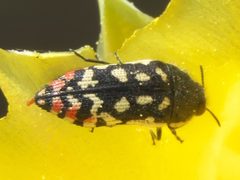
Acmaeodera paradisjuncta is a of metallic wood-boring beetle in the Buprestidae, described by Knull in 1940. It belongs to the large Acmaeodera, which contains numerous flower-visiting species. The species has been documented from Texas and is associated with flowering plants in dry, open . Like many , are likely attracted to flowers for feeding on pollen.
Pronunciation
How to pronounce Acmaeodera paradisjuncta: /ˌæk.miˈoʊ.dɛ.rə ˌpær.əˈdɪs.dʒʌŋk.tə/
These audio files are automatically generated. While they are not always 100% accurate, they are a good starting point.
Images
Habitat
Dry, open with flowering vegetation. In Texas, collected from roadside areas with abundant flowers in bloom.
Distribution
Central America and North America. Specifically documented from Val Verde County, Texas, USA. The name suggests a relationship to or distinction from A. disjuncta, which may indicate a southwestern U.S. and Mexican distribution pattern.
Seasonality
Active in late spring. Documented from field observations on May 17, 2022, in Texas.
Diet
feed on pollen from flowers. Documented visiting flowers of Wedelia hispida (Texas creeping-oxeye) and Thelosperma simplicifolium (slender greenthread).
Host Associations
- Wedelia hispida - food source collected on flowers
- Thelosperma simplicifolium - food source collected on flowers along with other Acmaeodera
Behavior
are flower visitors. Readily attracted to yellow composite flowers. Collected alongside other Acmaeodera including A. mixta, A. neoneglecta, A. starrae, and A. ornatoides, suggesting shared preferences and flower-visiting .
Ecological Role
Pollen-feeding beetles may contribute to pollination of flowers. Larval stage likely develops in woody plant material, as is typical for the Buprestidae, though specific host plants for larval development are not documented.
Similar Taxa
- Acmaeodera disjunctaClosely related indicated by the species epithet 'paradisjuncta'; likely similar in appearance and
- Acmaeodera mixtaCollected sympatrically on the same flowers; similar size and flower-visiting
- Acmaeodera neoneglectaCollected sympatrically; similar preferences and flower association
- Acmaeodera starraeCollected sympatrically on flowers; similar
- Acmaeodera ornatoidesCollected sympatrically on flowers; similar flower-visiting
More Details
Etymology
The epithet 'paradisjuncta' suggests a relationship to A. disjuncta, with 'para-' (Greek: beside, near) indicating close similarity or parapatric occurrence.
Collection method
Documented from sweeping and netting flowers rather than beating woody vegetation, indicating distinct from larval -seeking.
Taxonomic context
One of approximately 150 North American in the Acmaeodera, a diverse group of flower-visiting buprestids.