
Acmaeodera macra
Horn, 1878
metallic wood-boring beetle
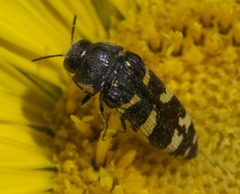
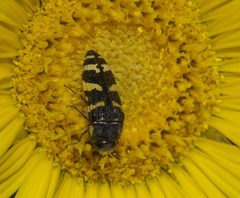
Acmaeodera macra is a of jewel beetle ( Buprestidae) notable for its unusual fall activity period, occurring from late August through September when most North American Acmaeodera species have finished their seasonal activity. are medium-sized with black coloration, bronzy sheen, and typically eight small yellow spots arranged in two longitudinal rows on each . The species occurs across the southern Great Plains and southwestern United States, with its northernmost records in northwestern Oklahoma.
Pronunciation
How to pronounce Acmaeodera macra: /ˌækmiˈoʊdərə ˈmækrə/
These audio files are automatically generated. While they are not always 100% accurate, they are a good starting point.
Identification
Acmaeodera macra can be distinguished from other Acmaeodera by its fall activity period (late August-September), black coloration with bronzy sheen, and eight small yellow spots forming two longitudinal rows on each . The species is most similar to A. tubulus but differs in its larger size, later seasonal occurrence, and geographic distribution. visiting flowers of Heterotheca stenophylla in fall are strongly indicative of this species in the southern Great Plains.
Images
Habitat
In Oklahoma, the appears restricted to vertical walls and talus slopes associated with the Blaine Escarpment, despite the widespread occurrence of its floral . The escarpment separates the Gypsum Hills and Red Hills physiographic regions.
Distribution
North America: southern Great Plains and southwestern United States. Documented from Texas (Rio Grande Valley and adjacent areas), Oklahoma (Blaine, Cleveland, Greer, Major, Oklahoma, and Woodward Counties), and Nuevo León, México. Alabaster Caverns State Park in Woodward County, Oklahoma represents the northernmost known locality.
Seasonality
Late August through September; fall-active when most other North American Acmaeodera have ceased activity.
Diet
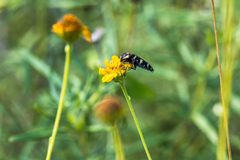
feed on pollen of composite flowers (Asteraceae), particularly Heterotheca stenophylla. Also recorded on Grindelia sp., Helianthus annuus, and Verbesina encelioides.
Host Associations
- Heterotheca stenophylla - FLORAL_HOSTPrimary ; stiffleaf false goldenaster
- Grindelia sp. - FLORAL_HOST
- Verbesina encelioides - FLORAL_HOST
- Helianthus annuus - FLORAL_HOST ; common sunflower
- Senegalia berlandieri - FLORAL_HOST ; previously Acacia berlandieri
Behavior
are and actively visit flowers to feed on pollen. The characteristic of Acmaeodera create a -like profile. When alarmed, adults may dodge to the backside of branches before zipping away.
Ecological Role
function as while feeding on pollen, with body hairs trapping and transferring pollen between flowers.
Human Relevance
Subject of entomological interest due to its unusual fall activity period and restricted distribution. Collected by enthusiasts and researchers studying buprestid .
Similar Taxa
- Acmaeodera tubulusSimilar black coloration with yellow spots, but A. tubulus is smaller (5-7mm), has spring-early summer activity, and occurs more widely in eastern North America
- Acmaeodera neglectaSimilar spotted pattern but has larger punctures, duller surface, and yellow spots often coalesced into irregular C-shaped markings; occurs primarily south-central U.S. in spring
Sources and further reading
- BugGuide
- Wikipedia
- GBIF taxonomy match
- iNaturalist taxon
- Catalogue of Life
- An uncommon fall-active Acmaeodera | Beetles In The Bush
- Cantharidae | Beetles In The Bush
- A flower visiting jewel beetle that is not an Acmaeodera | Beetles In The Bush
- Introducing Acmaeodera chuckbellamyi | Beetles In The Bush
- Springtime Acmaeodera | Beetles In The Bush
- Winter Botany Quiz #6 – answers and a checklist | Beetles In The Bush