
Acmaeodera labyrinthica
Fall, 1899
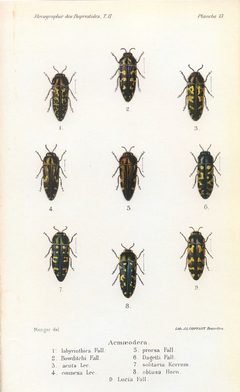
Acmaeodera labyrinthica is a metallic wood-boring beetle in the Buprestidae. It was described by Fall in 1899 and occurs in North America. Like other members of the large Acmaeodera, this exhibits metallic coloration and is associated with woody vegetation. The genus contains over 150 species in North America and is in need of taxonomic revision, with many species difficult to identify without comparison to determined specimens.
Pronunciation
How to pronounce Acmaeodera labyrinthica: /ækmiːoʊˈdɛrə læbɪˈrɪnθɪkə/
These audio files are automatically generated. While they are not always 100% accurate, they are a good starting point.
Identification
No specific distinguishing characters for A. labyrinthica are documented in the available sources. The belongs to the diverse Acmaeodera, whose members are generally characterized by metallic coloration, that do not separate in , and small to medium size (typically 5–12 mm). Species-level identification within Acmaeodera often requires examination of subtle morphological features including pronotal punctation, elytral , and maculation patterns, frequently necessitating comparison with authoritatively identified specimens due to the lack of comprehensive modern keys.
Images
Distribution
North America. Specific locality records are not detailed in available sources, but the occurs within the Nearctic region.
Similar Taxa
- Acmaeodera tubulusSimilar small size, black coloration with yellow elytral maculations, and membership in the 'tubulus- group' (though A. labyrinthica's specific group affiliation is unconfirmed). A. tubulus is widespread in eastern North America and can be distinguished by its bronzy sheen and typically eight small yellow spots arranged in two longitudinal rows on each .
- Acmaeodera neglectaResembles A. tubulus and potentially other small black Acmaeodera with yellow markings. Distinguished by larger punctures, duller surface, and yellow elytral spots often coalesced into irregular 'C'-shaped markings.
Sources and further reading
- BugGuide
- Wikipedia
- GBIF taxonomy match
- iNaturalist taxon
- Catalogue of Life
- An uncommon fall-active Acmaeodera | Beetles In The Bush
- Acmaeodera carlota in northern Arizona | Beetles In The Bush
- Introducing Acmaeodera chuckbellamyi | Beetles In The Bush
- A flower visiting jewel beetle that is not an Acmaeodera | Beetles In The Bush
- Springtime Acmaeodera | Beetles In The Bush
- Winter Botany Quiz #6 – answers and a checklist | Beetles In The Bush