
Acmaeodera flavomarginata
(Gray, 1832)
Yellow-margined Flower Buprestid
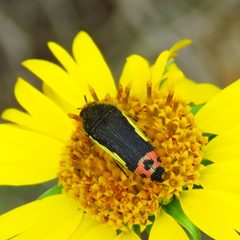
Acmaeodera flavomarginata is a of metallic wood-boring beetle in the Buprestidae. It is one of relatively few North American jewel beetles that exhibits fall activity, with emerging in autumn rather than the more typical spring-summer period seen in most . Adults are readily attracted to flowers, particularly those in the family Asteraceae, where they feed on pollen. The species has been documented across a broad geographic range spanning Central America, North America, and South America, with specific records from the southcentral United States including Texas and Oklahoma.


Pronunciation
How to pronounce Acmaeodera flavomarginata: //æk.mi.oʊˈdɛr.ə ˌflæv.oʊ.mɑr.dʒɪˈneɪ.tə//
These audio files are automatically generated. While they are not always 100% accurate, they are a good starting point.
Identification
Distinguished from other Acmaeodera by the combination of fall activity period and distinctive yellow-margined elytral pattern. The clean, bold coloration with yellow margins is particularly characteristic. In the southcentral United States, the fall activity period (September-November) helps separate this species from the majority of that are active in spring and early summer. The species belongs to the 'Truncatae' group within Acmaeodera, characterized by a nearly straight prosternal margin that is not retracted from the sides.
Images
Habitat
Open with flowering vegetation, particularly areas supporting asteraceous plants. In Oklahoma, has been associated with vertical walls and talus slopes where its flower occur. The shows affinity for disturbed or open areas where fall-blooming composites are abundant.
Distribution
Documented from Central America, North America, and South America. Specific records include the southcentral United States (Texas, Oklahoma), with the northernmost confirmed records from Woodward County, Oklahoma. The occurs along the Blaine Escarpment in Oklahoma and appears to follow this physiographic feature northward.
Seasonality
are active during fall (September-November), making this one of the few truly fall-active jewel beetles in North America. This seasonal pattern is unusual for the Acmaeodera, which is predominantly spring-early summer active across most of its range.
Diet
feed on pollen from flowers, particularly those of Asteraceae. Documented flower include Heterotheca stenophylla and Helianthus annuus. Larval host plants remain unknown.
Host Associations
- Heterotheca stenophylla - food plantPrimary flower in Oklahoma; visit for pollen
- Helianthus annuus - food plantDocumented flower in south Texas
Life Cycle
Complete with , larval, pupal, and stages. Larval and associations are unknown. Adults emerge in fall and are active during September-November, feeding on pollen before presumably or completing .
Behavior
are and actively visit flowers to feed on pollen. They are readily attracted to yellow-flowered Asteraceae in fall. When disturbed, adults may exhibit rapid escape typical of Buprestidae.
Ecological Role
function as while feeding on pollen. The contributes to fall pollination networks in regions where it occurs, utilizing a temporal (fall activity) that is relatively unexploited by other jewel beetles.
Human Relevance
Of interest to entomologists and coleopterists due to its unusual fall activity period and distinctive appearance. Not known to be of economic importance.
Similar Taxa
- Acmaeodera macraAlso fall-active in southcentral US, but has different elytral maculation pattern and more flattened surface with long, stiff, dark, suberect hairs
- Other Acmaeodera speciesMost are spring-early summer active; fall activity period helps distinguish A. flavomarginata in areas of sympatry
More Details
Activity Pattern
Fall activity is exceptional among North American Acmaeodera. Most in the are spring-early summer active, with only A. flavomarginata, A. macra, and a few others in southern Texas and adjacent regions showing true fall . This temporal isolation may reduce competition for flower resources.
Taxonomic Placement
Belongs to the 'Truncatae' group within Acmaeodera, characterized by prosternal margin nearly straight and not retracted from the sides. The has been placed in the informal A. tubulus-species group by some due to general resemblance in size and body form, though relationships within this group remain poorly resolved.
Sources and further reading
- BugGuide
- Wikipedia
- GBIF taxonomy match
- iNaturalist taxon
- Catalogue of Life
- Wasp Wednesday—Not! | Beetles In The Bush
- ESA Insect Macrophotography Workshop | Beetles In The Bush
- Membracidae | Beetles In The Bush
- An uncommon fall-active Acmaeodera | Beetles In The Bush
- Acmaeodera carlota in northern Arizona | Beetles In The Bush
- Winter Botany Quiz #6 – answers and a checklist | Beetles In The Bush