
Chrysobothris chrysoela
(Illiger, 1800)
Species Guides
1Chrysobothris chrysoela is a metallic wood-boring beetle in the Buprestidae, found in North America. The was described by Illiger in 1800 and includes two recognized : C. c. chrysoela and C. c. lerneri. Like other members of the , it belongs to the Chrysobothris femorata species group, a taxonomically challenging of wood-boring beetles that share morphological similarities and often require detailed examination of character suites for identification.
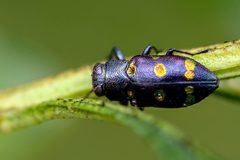
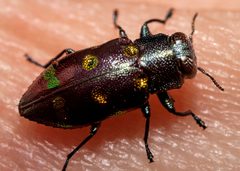
Pronunciation
How to pronounce Chrysobothris chrysoela: //ˌkrɪ.soʊˈbɒθ.rɪs ˌkrɪ.soʊˈiː.lə//
These audio files are automatically generated. While they are not always 100% accurate, they are a good starting point.
Identification
Members of the Chrysobothris femorata group, which includes C. chrysoela, are distinguished from one another by suites of subtle morphological characters rather than single diagnostic features. Identification typically requires examination of: antennal segment shape (narrowed versus quadrate apices); post- elytral foveae (circular impressions) and whether they are joined or separated; pygidial impression depth and presence or absence of hyaline lateral margins; elytral posteriolateral margin shape (arcuate versus straight) and tip coloration; elytral connectivity via cross-; and callosity shape and coloration. These characters must be evaluated in combination, as no single feature reliably distinguishes C. chrysoela from closely related species such as C. adelpha, C. comanche, C. femorata, C. quadriimpressa, C. rugosiceps, C. shawnee, or C. viridiceps.
Images
Distribution
North America. The has been recorded in the eastern United States, with specific observations from Florida.
Similar Taxa
- Chrysobothris femorataBoth belong to the Chrysobothris femorata group and share the general habitus of metallic wood-boring beetles in this . C. femorata differs in having straight elytral posteriolateral margins and reddish elytral tips, versus arcuate margins and bronze tips in C. chrysoela.
- Chrysobothris viridicepsBoth are members of the same group with overlapping geographic ranges. C. viridiceps is distinguished by having distinctly separated post- elytral foveae, whereas C. chrysoela has joined foveae.
- Chrysobothris rugosicepsBoth occur in the Chrysobothris femorata group with eastern North American distributions. C. rugosiceps has the last antennal segment strongly quadrate, while C. chrysoela has narrowed to the apex.
More Details
Subspecies
Two are recognized: Chrysobothris chrysoela chrysoela (nominate subspecies) and Chrysobothris chrysoela lerneri Cazier, 1951.
Taxonomic Context
The belongs to the Chrysobothris femorata species group, which was revised by Wellso and Manley (2007), nearly doubling the number of described species in the group. This revision highlighted the of cryptic diversity within what had previously been treated as a single widespread species, C. femorata.