
Chrysobothris viridiceps
Melsheimer, 1845
Chrysobothris viridiceps is a metallic wood-boring beetle in the Buprestidae, belonging to the taxonomically challenging Chrysobothris femorata -group. It is one of several closely related species that were historically confused under the catch-all name C. femorata until the 2007 revision by Wellso and Manley clarified species boundaries. The species is distinguished by diagnostic morphological characters and shows strong plant associations with oak species. It is found across eastern North America west to the Continental Divide.
Pronunciation
How to pronounce Chrysobothris viridiceps: //ˌkrɪsoʊˈbɒθrɪs vɪˌrɪdɪˈsɛps//
These audio files are automatically generated. While they are not always 100% accurate, they are a good starting point.
Identification
The most reliable field character is the uninterrupted elytral that completely divides the fovea—unique among C. femorata -group members. Males are readily identified by their bright green and distinctive bicolored with yellow portions. Females require closer examination but share the divided fovea character; they differ from other species by subtle combinations of pygidial impression depth, elytral margin shape, and callosity form. Microscopic examination may be needed for confident female identification. The species is smaller than C. shawnee and C. rugosiceps, with which it shares oak associations.
Images
Appearance
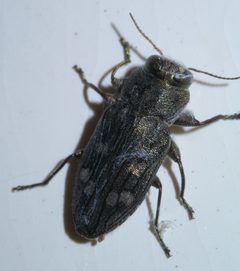
measure 7–13 mm in length. The body exhibits metallic coloration typical of the . Males have a bright green (), for which the is named, and uniquely within the C. femorata species-group, bicolored antennal segments with yellow outer portions and bright metallic green inner portions. Females lack the green face and have more uniformly reddish . Both sexes possess a diagnostic uninterrupted (raised narrow ridge) that completely bisects the elytral fovea (rounded pit); in all other C. femorata group species, this costa is interrupted by the fovea. Females tend to be more reddish on legs, antennae, and face compared to males.
Habitat
Hardwood forests, particularly those containing oak . are found on dead branches of trees. Within oak , the species shows a preference for the smallest dead branches compared to other oak-associated .
Distribution
Eastern United States and southern Canada, west to the Continental Divide. Documented from Manitoba, Ontario, and Québec in Canada. The range overlaps broadly with other members of the C. femorata -group.
Diet
Larvae bore into and feed on dead wood of plants. have been observed on dead branches of Quercus alba (white oak).
Host Associations
- Quercus - primary primarily associated with oak
- Carya - secondary reared from hickory
- Prosopis - secondary reared from mesquite
- Ulmus - secondary reared from elm
Life Cycle
Complete with , larval, pupal, and stages. Larvae are wood-borers that develop in dead branches of trees. Specific timing of and voltinism have not been documented.
Behavior
are and active on exposed dead branches in sunny conditions. They rely on cryptic coloration for avoidance and exhibit flash coloration (brilliant metallic blue-green segments exposed in ) when disturbed. The large, multifaceted are presumed to function in predator detection.
Ecological Role
As a primary decomposer of dead oak branches, contributes to nutrient cycling in hardwood forest . Part of a guild of closely related that partition resources by branch size, potentially reducing .
Human Relevance
Not considered a significant economic pest. Distinguished from C. femorata sensu stricto, which is an important pest of ornamental and fruit trees. The has contributed to taxonomic understanding of a historically problematic .
Similar Taxa
- Chrysobothris caddoSimilar size and metallic coloration; distinguished by joined (not separated) post- elytral foveae and different association (primarily Celtis, not Quercus)
- Chrysobothris quadriimpressaAlso oak-associated; distinguished by shallowly impressed and preference for larger branches
- Chrysobothris rugosicepsOak-associated but larger; distinguished by strongly quadrate last antennal segment and preference for very large branches and upper trunk
- Chrysobothris shawneeOak-associated but largest in group (9–18 mm); distinguished by larger bronze-black callosities and preference for large trunks and stumps
- Chrysobothris femorataFormerly confused with C. viridiceps; distinguished by straight (not arcuate) posteriolateral elytral margins and reddish (not bronze) elytral tips, and association with stressed living trees of various rather than dead oak branches
More Details
Taxonomic History
Historically included within the catch-all Chrysobothris femorata until the 2007 revision by Wellso and Manley, which formally described several new and clarified species limits within the group. The revision relied on suites of subtle morphological characters rather than single diagnostic features.
Resource Partitioning
Among the four oak-associated in the C. femorata group (C. viridiceps, C. quadriimpressa, C. rugosiceps, C. shawnee), branch size preferences appear to correlate with body size, with C. viridiceps (smallest) on smallest branches and C. shawnee (largest) on trunks and stumps.