
Chrysobothris rugosiceps
Melsheimer, 1845
Chrysobothris rugosiceps is a metallic wood-boring beetle in the Buprestidae, first described by Melsheimer in 1845. It belongs to the taxonomically challenging C. femorata group, which was revised in 2007 to include twelve species. The original is lost, and a neotype has been designated. are active on dead oak branches and trunks during daylight hours.
Pronunciation
How to pronounce Chrysobothris rugosiceps: //ˌkɹɪsəˈbɒθɹɪs ˌruːˈɡoʊsɪˌsɛps//
These audio files are automatically generated. While they are not always 100% accurate, they are a good starting point.
Identification
Distinguished from C. caddo by the strongly quadrate last antennal segment (versus narrowed to apex in C. caddo). Differs from C. viridiceps by having the post- elytral foveae joined or connected (versus distinctly separated in C. viridiceps). Distinguished from C. quadriimpressa by the deeply impressed on each side of the middle in females (versus shallowly impressed in C. quadriimpressa), and by larger size. Identification requires microscopic examination of female pygidium and male genitalia for definitive confirmation. The is one of four oak-associated members of the C. femorata group occurring in Missouri.
Images
Appearance
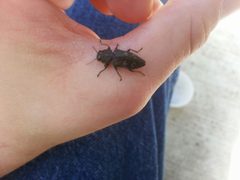
are metallic wood-boring beetles with cryptic bark-matching coloration. The is larger than C. quadriimpressa, with adults typically measuring larger than the ~10-12 mm length of that species. The last antennal segment is strongly quadrate (square-shaped), a diagnostic feature distinguishing it from C. caddo, which has narrowed to the apex. The () has elevated patches (callosities) that are transverse and bronze in coloration. possess post- foveae (circular impressions) and longitudinal (ridges).
Habitat
Associated with dead oak wood, particularly larger branches and upper trunk sections of oak trees. are found on recently fallen or dead standing oak trees exposed to full sun. The shows a preference for larger diameter wood compared to , with C. rugosiceps occupying larger branches and upper trunks while C. viridiceps occurs on smaller branches and C. quadriimpressa on intermediate-sized branches.
Distribution
Eastern United States and southern Canada, west to Texas. Specific records include Manitoba, Ontario, Québec, and Saskatchewan in Canada. The occurs broadly across the eastern deciduous forest region and extends into the central United States.
Seasonality
are active during daylight hours and are attracted to recently wind-thrown or dead oak trees. Activity period overlaps with other members of the C. femorata group, though specific seasonal timing is not well documented.
Host Associations
- Quercus - primary primarily associated with oaks; found on dead branches and trunks
- Castanea - secondary reared from this
Life Cycle
Larvae are wood-borers that develop within dead oak branches and trunks. are laid on bark cracks of dead or stressed trees. Larvae hatch and bore into the wood, feeding on the phloem and cambium layers. Development occurs within the wood, with emerging through exit holes. Specific details on instar number, developmental duration, and site are not documented.
Behavior
are and actively search dead oak trees for mates and oviposition sites. They are highly wary and difficult to approach, with large providing excellent vision for detection. When alarmed, they exhibit rapid escape , exposing bright metallic blue-green abdominal coloration (flash coloration) that may confuse predators. Adults communicate by tapping their against wood. They are notoriously difficult to photograph due to their alertness and quick flight response.
Ecological Role
As a primary consumer of dead oak wood, contributes to nutrient cycling and wood decomposition in hardwood forest . The is part of a guild of wood-boring beetles that accelerates the breakdown of dead woody material. Its specific size preferences (larger branches and upper trunks) suggest partitioning with , potentially reducing .
Human Relevance
Not an economic pest of living trees. May be encountered by entomologists and collectors on dead oak wood. The was historically confused with other members of the C. femorata group, which includes C. femorata sensu stricto, an important pest of shade and fruit trees. Proper identification is relevant for distinguishing non-pest species from economically damaging relatives.
Similar Taxa
- Chrysobothris caddoSimilar size and appearance, but distinguished by quadrate versus narrowed antennal apices
- Chrysobothris viridicepsAlso oak-associated, but has distinctly separated post- elytral foveae versus joined foveae in C. rugosiceps
- Chrysobothris quadriimpressaOverlaps in but smaller in size and has shallowly impressed female
- Chrysobothris shawneeAlso oak-associated and larger in size, but has larger bronze-black callosities on versus transverse bronze callosities in C. rugosiceps
Misconceptions
Historically confused with other members of the C. femorata group under the catch-all 'Chrysobothris femorata' prior to the 2007 revision by Wellso and Manley. The blue feet, shared with other cryptically colored Chrysobothris species, have been speculated to function in diversion, , or UV reflectance, but their adaptive significance remains unexplained.
More Details
Taxonomic history
The original is lost; a neotype was designated by Wellso and Manley (2007) in their revision of the C. femorata group. The species was one of six new species formally recognized in that revision, though it had been described originally in 1845.
Species group context
One of twelve in the C. femorata species group, with eleven species associated with deciduous trees and one (C. seminole) associated with woody goldenrod. The group represents a taxonomically challenging complex of recently diverged species with subtle morphological differences and partitioning.
Sources and further reading
- BugGuide
- Wikipedia
- GBIF taxonomy match
- iNaturalist taxon
- NCBI Taxonomy
- Catalogue of Life
- Introducing Chrysobothris caddo | Beetles In The Bush
- Oklahoma | Beetles In The Bush | Page 9
- Chrysobothris viridiceps | Beetles In The Bush
- An irresistible sight! | Beetles In The Bush
- June | 2010 | Beetles In The Bush | Page 2
- The perfectly polyphagous Chrysobothris purpureovittata | Beetles In The Bush
- A revision of the Chrysobothris femorata (Olivier, 1790) species group from North America, north of Mexico (Coleoptera: Buprestidae)