
Buprestis lyrata
Casey, 1909
pink-faced jewel beetle
Buprestis lyrata is a of metallic wood-boring beetle in the Buprestidae, first described by Thomas L. Casey in 1909. It is found in the Nearctic region, primarily in western North America including Alberta and British Columbia in Canada. are known to frequent freshly dead conifers, particularly Douglas-fir (Pseudotsuga menziesii), where they can be found on trunks and branches. The species is part of the diverse Buprestis, which contains many colorful and sought-after jewel beetles among collectors.
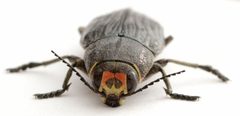
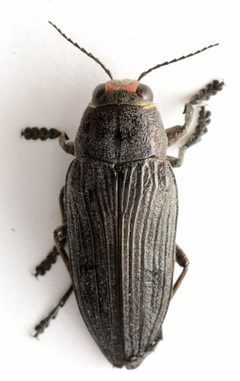
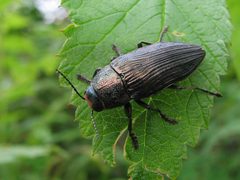
Pronunciation
How to pronounce Buprestis lyrata: //buˈprɛstɪs laɪˈreɪtə//
These audio files are automatically generated. While they are not always 100% accurate, they are a good starting point.
Identification
Buprestis lyrata is a member of the subgenus Cypriacis within the Buprestis, characterized by with alternate intervals depressed and heavily punctate, giving the a strongly ribbed appearance. The name "lyrata" refers to the lyre-shaped markings on the elytra. are metallic in coloration, typical of the genus. The pink-faced likely refers to coloration on the or pronotum. As with many Buprestis species, B. lyrata is relatively large and not particularly skittish compared to faster-flying relatives like Chrysobothris, making it somewhat easier to capture once located.
Images
Habitat
Found in alpine coniferous forest . are associated with freshly dead conifer trees, particularly Douglas-fir (Pseudotsuga menziesii), where they occur on trunks and branches. The has been collected at elevations around 9000 feet in montane coniferous forest settings with dense forest cover.
Distribution
Nearctic region: North America. Documented from Alberta and British Columbia in Canada. The appears to have a western North American distribution, though precise range boundaries are not well documented in available sources.
Seasonality
activity has been observed in late June. Based on related in the , adults likely emerge in late spring to early summer and may be active through mid-summer, though specific data for this species is limited.
Host Associations
- Pseudotsuga menziesii - breeding Douglas-fir; larvae develop in dead wood, found on freshly dead trunks and branches
Behavior
are known to return repeatedly to the same tree, making them somewhat predictable to locate. They are not particularly skittish and can be approached carefully for collection. When disturbed, they may fly short distances but often return to or remain near the host tree.
Ecological Role
As a wood-boring , larvae contribute to decomposition of dead conifer wood and nutrient cycling in forest . The is part of the guild of insects that colonize recently dead trees, facilitating breakdown of woody material.
Human Relevance
Of interest to coleopterists and collectors due to its attractive metallic coloration and membership in the desirable Buprestis. Not considered a significant pest of living trees. The is documented in citizen science platforms with over 900 observations, indicating moderate detectability by naturalists.
Similar Taxa
- Buprestis striataBoth are members of subgenus Cypriacis with ribbed ; B. striata has more distinct longitudinal striations and different coloration, and occurs in eastern North America on Virginia pine
- Buprestis salisburyensisBoth are medium to large Buprestis with metallic coloration; B. salisburyensis is brilliant blue-green with red elytral margins and occurs in eastern North America, associated with young pine needles
- Buprestis confluentaBoth are large, showy Buprestis ; B. confluenta is brilliant green with yellow flecks and primarily associated with cottonwood and aspen in central North America
- Chrysobothris spp.Similar size and metallic appearance, but Chrysobothris are generally smaller, faster-flying, and more skittish, with different elytral
More Details
Taxonomic placement
Buprestis lyrata is placed in subgenus Cypriacis, one of several subgenera within the large Buprestis. The subgenus is characterized by depressed and heavily punctate alternate elytral intervals creating a ribbed appearance.
Collection notes
Based on field observations, the can be collected by carefully approaching on tree trunks and using a net or vial. The tendency of adults to return to the same tree allows for repeated collection attempts at productive locations.