
Buprestis aurulenta
Linnaeus, 1767
golden jewel beetle, golden buprestid, Golden Buprestid Beetle
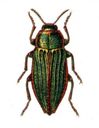
Buprestis aurulenta, commonly known as the golden jewel or golden buprestid, is a striking metallic wood-boring beetle native to western North America. display brilliant iridescent green coloration with orange margins on the . The is notable for its exceptionally prolonged larval development, with documented cases of larvae surviving 47 years or more in dry wood before emerging as adults. This longevity makes it one of the most long-lived beetle species known.
Pronunciation
How to pronounce Buprestis aurulenta: /bʌˈprɛstɪs ɔːˈrulɛntə/
These audio files are automatically generated. While they are not always 100% accurate, they are a good starting point.
Identification
are distinguished by their iridescent green body with shining orange trim around the margins of the wing covers (). The metallic coloration is vivid and distinctive. Larvae are wood-borers with the typical flattened, elongate form characteristic of Buprestidae, though they are rarely observed directly.
Images
Habitat
Larvae develop inside coniferous trees and can survive for extended periods in dry, seasoned wood. have been observed on large, dead, bark-less cottonwood trunks and other exposed wood surfaces. The is associated with both living trees and structural timber, including log houses built from forest-cut logs.
Distribution
Native to western North America. Found in the Pacific Northwest from southern British Columbia southward through the Rocky Mountains to Mexico. Rare in Alberta with scattered records from Manitoba. Introduced specimens have been recorded outside native range, including a notable in Essex, UK, from imported timber.
Host Associations
- coniferous trees - larval larvae live inside a variety of coniferous
- cottonwood (Populus deltoides) - association observed on large dead trunks
- structural wood/timber - larval can develop in seasoned wood of log houses and other construction
Life Cycle
Larval development is exceptionally prolonged. Documented cases include larvae surviving at least 47 years in dry wood before . One record describes adults emerging from logs cut in 1946-47 with first emergence in 1956, indicating approximately 9-10 years development. Some Buprestis overwinter as adults in pupal ; others overwinter as pupae and become adults in spring, with emergence early in the following season.
Behavior
are relatively calm and disinclined to flee when approached, making them easier to capture than more skittish buprestid such as Chrysobothris. Adults have been maintained under artificial laboratory conditions to study longevity and .
Ecological Role
Wood-boring with extended development in timber. beetles carry diverse fungal associates, primarily hyphomycetes (91.4% of isolations), with limited evidence of consistent vectoring of decay fungi into woody debris.
Human Relevance
Notable for causing unexpected emergences in structural timber, including log houses and staircases, decades after construction. The 1983 from a staircase in Essex, UK, after at least 47 years as a larva, demonstrates the ' remarkable longevity and potential for surprise appearances in human environments.
Similar Taxa
- Buprestis confluentasimilar and metallic appearance, but B. confluenta shows brilliant green with yellow flecks rather than orange trim, and is associated with cottonwood/aspen rather than conifers
- Buprestis striataboth in Buprestis, but B. striata has strongly ribbed with alternate intervals depressed and heavily punctate, lacking the orange marginal coloration
- Buprestis salisburyensissimilar size and metallic coloration, but B. salisburyensis is brilliant blue-green with bright red elytral edges rather than green with orange trim, and has large elytral punctures characteristic of subgenus Stereosa
Sources and further reading
- BugGuide
- Wikipedia
- GBIF taxonomy match
- iNaturalist taxon
- NCBI Taxonomy
- Catalogue of Life
- The Buprestis tree | Beetles In The Bush
- A Buprestis hat-trick! | Beetles In The Bush
- Tiger Beetles Show Potential for Biocontrol of Red Imported Fire Ants
- Cartref Anghonfensiynol i’r Saerwenynen Eddi Aur - Buglife Blog - Buglife
- The invasion that wasn’t | Beetles In The Bush
- An Unconventional Home for the Gold-fringed Mason Bee - Buglife Blog - Buglife
- Fungal associates of Buprestis aurulenta in western Oregon
- A Note on the Longevity and Behaviour of Adult Golden Buprestids, Buprestis aurulenta L. (Coleoptera: Buprestidae) Under Artificial Conditions