
Agaeocera
Saunders, 1871
Species Guides
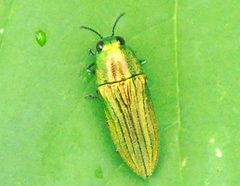
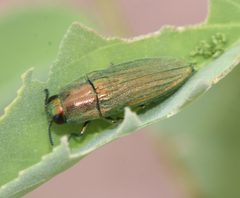
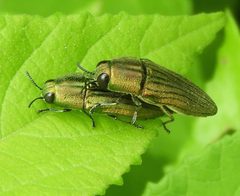
2Agaeocera is a of metallic wood-boring beetles in the Buprestidae, containing three described : A. gentilis, A. gigas, and A. scintillans. The genus was established by Saunders in 1871. Based on field observations, of A. gentilis have been collected from Sphaeralcea (globemallow) plants in the southwestern United States and Mexico.
Pronunciation
How to pronounce Agaeocera: /ˌæɡiˈoʊsərə/
These audio files are automatically generated. While they are not always 100% accurate, they are a good starting point.
Identification
The Agaeocera can be distinguished from similar buprestid genera by its large size and metallic coloration. Agaeocera gentilis specifically has been noted as a large, vittate (striped) . However, detailed diagnostic characters separating Agaeocera from related genera such as Lampetis or other large buprestids are not well documented in available sources.
Images
Habitat
Agaeocera gentilis has been observed in association with Sphaeralcea angustifolia (narrow-leaved globemallow) and Sphaeralcea hastulata (spear globemallow) in desert scrub and grassland . The appears to inhabit arid and semi-arid regions of the southwestern United States and adjacent Mexico.
Distribution
The occurs in the southwestern United States (Texas, New Mexico, Arizona) and Mexico. Specific distribution records include western Texas, southern New Mexico, and southeastern Arizona.
Seasonality
of Agaeocera gentilis have been collected in late July, suggesting summer activity. The timing corresponds with the flowering period of Sphaeralcea plants.
Host Associations
- Sphaeralcea angustifolia - association observed perched on foliage and swept from plants
- Sphaeralcea hastulata - association collected by sweeping through stands of this globemallow
Behavior
have been observed perched on leaves of plants. They have been collected by sweeping vegetation and beating host plants onto sheets, suggesting they are active on foliage during daylight hours.
Similar Taxa
- LampetisBoth are large, metallic buprestid that can be found in similar and on similar plants. Agaeocera can be distinguished by specific elytral patterns and body proportions, though detailed comparisons require examination of .
- AgrilusSome Agrilus are similarly vittate (striped) and occur on the same plants. Agaeocera is notably larger in body size than most Agrilus species.
More Details
Species composition
The contains three described : Agaeocera gentilis (Horn, 1885), Agaeocera gigas (Gory & Laporte, 1839), and Agaeocera scintillans Waterhouse, 1882. Agaeocera gigas is the type species of the genus.
Taxonomic history
The was established by Saunders in 1871. The authorship is sometimes cited as 'Saunders, 1871' in taxonomic databases.
Collection methodology
Based on field observations by MacRae (2021), Agaeocera gentilis was collected by sweeping through stands of Sphaeralcea globemallows, with specimens observed both in and perched on leaves. This suggests the may be more readily collected by active sweeping of vegetation rather than passive beating of woody plants.