
Agaeocera gentilis
(Horn, 1885)
Agaeocera gentilis is a metallic wood-boring beetle in the Buprestidae. The occurs in southwestern North America and Central America, with two recognized : A. g. gentilis and A. g. peninsularis. Field observations indicate are active during summer months and have been collected from Sphaeralcea (globemallow) vegetation.
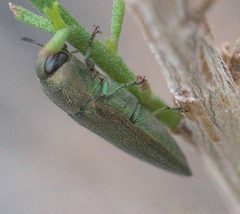
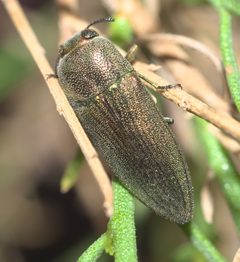
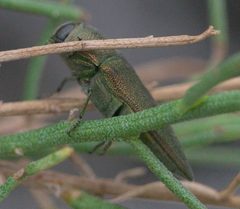
Pronunciation
How to pronounce Agaeocera gentilis: /əˈɡiːoʊˌsɛrə dʒɛnˈtɪlɪs/
These audio files are automatically generated. While they are not always 100% accurate, they are a good starting point.
Identification
Agaeocera gentilis can be distinguished from other North American buprestid by its association with the genus Agaeocera. The two —A. g. gentilis and A. g. peninsularis—differ in geographic distribution, with the nominate form occurring in mainland regions and peninsularis restricted to Baja California.
Images
Habitat
Arid and semi-arid regions with globemallow (Sphaeralcea) vegetation. Observations from western Texas and New Mexico indicate presence in roadside stands of Sphaeralcea angustifolia and S. hastulata in creosote scrub and desert grassland .
Distribution
North America (southwestern United States: Texas, New Mexico, Arizona) and Central America. The A. g. peninsularis occurs in Baja California.
Seasonality
active in summer; collected in July in western Texas and New Mexico.
Host Associations
- Sphaeralcea angustifolia - associated withnarrow-leaved globemallow
- Sphaeralcea hastulata - associated withspear globemallow
Behavior
have been observed perched on globemallow foliage and swept from vegetation.
Similar Taxa
- AgrilusSympatric buprestid with vittate collected in same ; Agaeocera distinguished by genus-level characters and associations
- AcmaeoderaCo-occurring metallic buprestid ; differs in size, elytral , and typical flower-visiting