
Pachyschelus
Solier, 1833
Species Guides
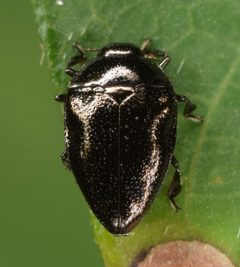
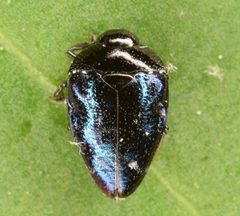
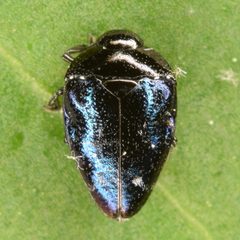
8Pachyschelus is a of metallic wood-boring beetles in the Buprestidae, containing at least 270 described . Members are small, flattened leaf-miners distinguished from other buprestids by their highly derived : compact, wedge-shaped bodies adapted for living between leaf surfaces rather than boring through wood. The genus belongs to the tribe Trachyini, whose larvae mine leaves of herbaceous plants rather than stems or trunks. Species occur primarily in the Neotropics, with some extending into North America.
Pronunciation
How to pronounce Pachyschelus: //pəˈkɪskɪləs//
These audio files are automatically generated. While they are not always 100% accurate, they are a good starting point.
Identification
Distinguished from other buprestid by the combination of small size (typically under 5 mm), flattened compact body, and wedge-shaped profile. Differs from related leaf-mining genus Brachys (which mines oak leaves) by association with herbaceous plants rather than hardwoods. Separated from Taphrocerus (another Trachyini genus) by plant : Pachyschelus primarily associated with Fabaceae and other herbaceous families, while Taphrocerus mines sedge leaves. Specific identification to level requires examination of coloration, patterns, and male genitalia.
Images
Habitat
Associated with herbaceous vegetation in forest edges, open woodlands, and prairie . Larval habitat is within leaf tissue of plants; found on host plant foliage. One studied in Brazil occupied semideciduous forest edges along trails and forest borders.
Distribution
Primarily Neotropical distribution. Records from South America (Brazil, Peru, Ecuador, Argentina), Central America, and North America (United States). Specific documented locations include: Serra do Japi Reserve, Jundiaí, São Paulo, Brazil (23°16'S, 47°00'W); Tingo María, Río Huallaga, Peru; El Puyo, Ecuador; and multiple U.S. states including Illinois, Missouri, and Virginia.
Seasonality
activity varies by and latitude. Pachyschelus purpureus active in early spring in North America. Pachyschelus coeruleipennis reproductive season December to June in Brazil. Some species may be , though this requires confirmation.
Diet
Larvae are leaf miners feeding internally on leaf tissue of plants. feed on foliage of host plants, with some observed feeding on upper leaf surfaces.
Host Associations
- Croton floribundus - larval Euphorbiaceae; only used by P. coeruleipennis despite three other Croton present at study site
- Geranium maculatum - and larval wild geranium; confirmed for P. purpureus
- Lespedeza - confirmed for P. laevigatus
- Apios americana - groundnut; for P. nicolayi
- Wisteria frutescens - American wisteria; for P. nicolayi
Life Cycle
laid singly on underside of leaves, typically beside midvein or at junction of secondary ribs. Three larval instars; development takes approximately one month. First instar mines average 41 mm long by 1 mm thick; second instar mines 64 mm; third instar mines 152 mm by 3 mm thick. Third instar larvae cross leaf midvein and pupate within leaf. Pupal measure approximately 10 mm diameter, fall to soil after a few days, with emerging from soil. Some evidence suggests possible in some , though this is not confirmed.
Behavior
feed and copulate on upper surfaces of plant leaves. Females exhibit preferential oviposition in young leaves. remain attached to leaves after larval . Pupal detach from leaves and fall to ground for adult .
Ecological Role
Herbivore/. Subject to significant and pressure; and account for majority of mortality. Mortality patterns show seasonal variation: parasitism greater late in season, predation greater early in season. Contributes to documented leaf miner mortality patterns comparable to temperate and tropical buprestid leaf miners.
Human Relevance
Collected for entomological study and private collections. Some have been subjects of detailed ecological study. No significant economic impact documented; not considered agricultural pests.
Similar Taxa
- BrachysAlso in tribe Trachyini with leaf-mining larvae, but Brachys mines leaves of hardwoods (chiefly Quercus) rather than herbaceous plants; slightly larger and with different patterns
- TaphrocerusAlso in tribe Trachyini with leaf-mining habit, but restricted to sedges (Cyperaceae) rather than Fabaceae and other herbaceous
- MastogeniusSmall buprestids (~2 mm) but not leaf miners; different body form and
More Details
Taxonomic history
The name is masculine, requiring masculine epithets (e.g., Pachyschelus huallagus, not huallaga). Described by Solier in 1833.
Research significance
Pachyschelus coeruleipennis has been subject of detailed ecological study, providing quantitative data on distribution, mortality sources, and patterns in Neotropical leaf miners.
Sources and further reading
- BugGuide
- Wikipedia
- GBIF taxonomy match
- iNaturalist taxon
- NCBI Taxonomy
- Catalogue of Life
- Brachys on oak | Beetles In The Bush
- Buprestidae | Beetles In The Bush | Page 6
- Some recent publications | Beetles In The Bush
- Berberidaceae | Beetles In The Bush
- Clutch Size, Survivorship, and Biology of Larval Pachyschelus psychotriae Fisher (Coleoptera: Buprestidae)
- Distribution, survivorship and mortality sources in immature stages of the neotropical leaf miner Pachyschelus coeruleipennis Kerremans (Coleoptera: Buprestidae)