
Brachys aerosus
Melsheimer, 1845
Northern Red Oak Jewel Beetle
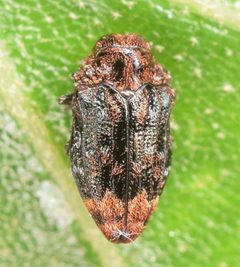
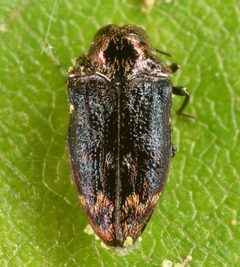
Brachys aerosus is a small metallic wood-boring beetle in the Buprestidae, tribe Trachyini. measure 3–5 mm in length and exhibit highly variable coloration, with the basal region of the typically showing purple, blue, or green luster and the area covered in gold to bronze . The is commonly associated with hardwood trees, particularly oaks and elms, though its broad range and morphological variability suggest it may represent a cryptic . Larvae are leaf miners rather than wood borers, a distinctive trait of the tribe Trachyini.
Pronunciation
How to pronounce Brachys aerosus: //ˈbrækɪs eɪˈroʊsəs//
These audio files are automatically generated. While they are not always 100% accurate, they are a good starting point.
Identification
Distinguished from by combination of size (3–5 mm, smaller than B. ovatus), pattern (basal lacking pubescence with metallic luster, area with gold to bronze setae), and association with multiple hardwood . B. ovatus is larger (usually >5 mm), has dense row of long hairs along apex of last abdominal sternum, and white-margined band of bronze pubescence before elytral apex. B. aeruginosus is smaller (3–4 mm) with predominantly light gold to silver setae on apical elytra.
Images
Habitat
Hardwood forests and woodlands. Associated with trees in marginal including forest edges, roadsides, and disturbed areas.
Distribution
North America. Documented from Canada (Alberta, British Columbia, Manitoba, New Brunswick) and throughout the United States.
Diet
Larvae mine leaves of hardwood trees. have been collected on oaks (Quercus) and elms (Ulmus) in Missouri; literature reports (mostly old and unreliable) cite additional including Castanea, Fagus, Corylus, Carya, Carpinus, Tilia, Populus, Vaccinium, and Vitis.
Host Associations
- Quercus - larval primary ; verified collections
- Ulmus - larval verified collections in Missouri
- Castanea - suspected larval literature report, unverified
- Fagus - suspected larval literature report, unverified
- Corylus - suspected larval literature report, unverified
- Carya - suspected larval literature report, unverified
- Carpinus - suspected larval literature report, unverified
- Tilia - suspected larval literature report, unverified
- Populus - suspected larval literature report, unverified
- Vaccinium - suspected larval literature report, considered unlikely
- Vitis - suspected larval literature report, considered unlikely
Life Cycle
deposited in leaf tissue. Larvae develop as leaf miners within leaves of plants, feeding between upper and lower . presumably occurs within leaf mine or in soil. active during spring. Specific details of developmental timing and stage unknown.
Behavior
active on foliage. Leaf-mining larvae create distinctive mines within host leaves.
Ecological Role
on hardwood trees. Role in nutrient cycling through leaf tissue processing. Potential prey for and , though specific relationships undocumented.
Human Relevance
No documented economic importance. Occasionally encountered by collectors and naturalists.
Similar Taxa
- Brachys ovatusLarger size (>5 mm vs. 3–5 mm), dense row of long hairs on apex of last abdominal sternum, white-margined band of bronze before elytral apex, primarily oak-associated
- Brachys aeruginosusSmaller size (3–4 mm), predominantly light gold to silver setae on (vs. gold to bronze in B. aerosus), less commonly encountered
- Acmaeodera spp.Larger size, elongate cylindrical body form, wood-boring larvae (not leaf miners), different patterns
Misconceptions
Historical literature reports of broad range including such as Vaccinium and Vitis are considered unreliable and may reflect incidental associations rather than true larval host relationships. The ' high variability and broad purported host range have led to speculation that B. aerosus represents a cryptic , but this remains unresolved due to loss of unpublished research by George Vogt.
Sources and further reading
- BugGuide
- Wikipedia
- GBIF taxonomy match
- iNaturalist taxon
- NCBI Taxonomy
- Catalogue of Life
- List of Species Fact Sheets| Grasshoppers of Wyoming and the West
- Grasshoppers of Colorado
- Brachys on oak | Beetles In The Bush
- Bug Eric: The Homesteader (Plains Lubber grasshopper)
- Monster in the Night | Beetles In The Bush
- Bug Eric: The Grasshopper Hunt