
Brachys aeruginosus
Gory, 1841
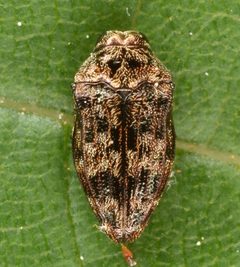
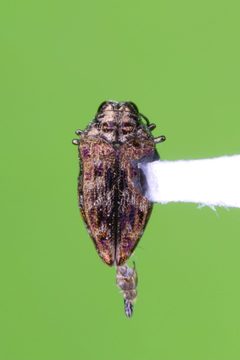
Brachys aeruginosus is a small metallic wood-boring beetle in the Buprestidae, first described by Gory in 1841. It belongs to the tribe Trachyini, a group characterized by flattened, compact, wedge-shaped whose larvae mine within leaves rather than boring through wood. The is uncommonly encountered compared to and is most often associated with oaks. It is found in North America, with records from Canada (Manitoba, Ontario, Québec) and the United States.
Pronunciation
How to pronounce Brachys aeruginosus: /ˈbrækiːz aɪˌruːdʒəˈnoʊsəs/
These audio files are automatically generated. While they are not always 100% accurate, they are a good starting point.
Identification
Distinguished from the larger Brachys ovatus (5+ mm) by size and by lacking the dense row of long hairs along the apex of the last abdominal sternum. Separated from the variable Brachys aerosus (3–5 mm) by the predominantly light gold to silver setae covering the , whereas B. aerosus shows predominantly gold to bronze in this region. B. aerosus also typically shows purple, blue, or green luster on the basal elytra with reduced pubescence.
Images
Habitat
Hardwood forests, particularly oak-dominated woodlands. Associated with oak foliage where are collected; specific microhabitat preferences for larvae are undocumented but presumably within leaf tissue of plants.
Distribution
North America. Documented from Canada: Manitoba, Ontario, and Québec. United States records exist but specific states are not detailed in available sources. One field observation notes a specimen from the Oklahoma panhandle as a potentially unusual far western record.
Seasonality
have been observed in spring. Specific is poorly documented, but in Missouri are active during spring.
Diet
Larval stage mines within leaves of plants, presumably oaks. feeding habits are not specifically documented for this , but related Brachys species feed on oak foliage.
Host Associations
- Quercus - larval presumed; most often collected on oaks
Life Cycle
are presumably deposited on or near plant leaves. Larvae are leaf miners, feeding within leaf tissue rather than boring wood. likely occurs within the leaf or in soil. emerge in spring. Detailed documentation is lacking for this specifically.
Behavior
are likely torpid in cool conditions, as observed in related buprestids. Specific behavioral observations for B. aeruginosus are not documented.
Ecological Role
As a leaf-mining , larvae contribute to nutrient cycling in hardwood forest . Their impact on plant health is likely minimal given their small size and uncommonly encountered status.
Human Relevance
No documented economic or agricultural significance. Occasionally encountered by entomologists conducting beating or sweeping oak foliage.
Similar Taxa
- Brachys aerosusOverlaps in size range and general appearance; distinguished by gold to bronze (not light gold to silver) elytral and typically shows purple/blue/green luster on basal
- Brachys ovatusLarger (5+ mm vs. 3–4 mm), with distinctive dense row of long hairs on last abdominal sternum and white-margined band of bronze before elytral apex
More Details
Taxonomic note
Brachys aerosus is suspected to be a due to its variability and broad associations. The late George Vogt conducted extensive rearing studies but died before publishing; his cryptic notes make publication unlikely. Whether B. aeruginosus represents a distinct or part of broader variation requires further study.
Collection note
The is uncommonly encountered in fieldwork. A specimen tentatively identified as B. aeruginosus from the Oklahoma panhandle represents a potentially significant western range extension if confirmed.
Sources and further reading
- BugGuide
- Wikipedia
- GBIF taxonomy match
- iNaturalist taxon
- NCBI Taxonomy
- Catalogue of Life
- List of Species Fact Sheets| Grasshoppers of Wyoming and the West
- Grasshoppers of Colorado
- Brachys on oak | Beetles In The Bush
- Scathophagidae | Beetles In The Bush
- Bug Eric: The Homesteader (Plains Lubber grasshopper)
- Monster in the Night | Beetles In The Bush