
Agrilus walsinghami
Crotch, 1873
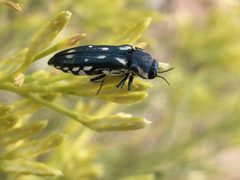
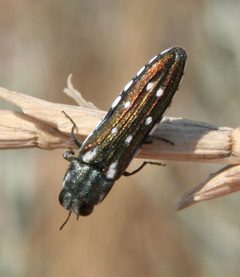
Agrilus walsinghami is a sexually dimorphic jewel beetle ( Buprestidae) found across western North America. It is among the most visually striking in its , with males exhibiting bronzy-brown and brassy coloration while females are uniformly blue to greenish-blue. are active during late summer and early fall, an unusual seasonality for wood-boring beetles in this region. The species is strongly associated with gray rabbitbrush (Ericameria nauseosa), which is presumed to serve as its larval despite the absence of confirmed rearing records.
Pronunciation
How to pronounce Agrilus walsinghami: /ˈæɡrɪləs wɑːlˈsɪŋhəmiː/
These audio files are automatically generated. While they are not always 100% accurate, they are a good starting point.
Identification
Distinguished from by combination of , coloration patterns, and association. Males recognized by bronzy-brown /pronotum and brassy ; females by uniform blue-green coloration. Both sexes show distinctive white lateral pubescent patches. No other western Agrilus combines this color pattern with late-season activity on gray rabbitbrush.
Images
Appearance
Sexually dimorphic with pronounced color differences between sexes. Males: and pronotum bronzy brown with faint coppery reflections; brassy with slight purplish tints. Females: larger and more robust, uniformly blue to greenish blue above. Both sexes have underside strongly bronzy green with prominent white densely pubescent patches along lateral portions of and . Legs more or less coppery.
Habitat
Sagebrush and arid shrubland in western North America. encountered almost exclusively on gray rabbitbrush (Ericameria nauseosa).
Distribution
Western North America from British Columbia south to Baja California and east to Colorado. Documented from Nevada, California, Utah, Colorado, and British Columbia.
Seasonality
activity from mid-July to mid-September, with peak activity in late summer and early fall. This represents an unusual late-season for wood-boring beetles in the western United States.
Host Associations
- Ericameria nauseosa - presumed larval encountered almost exclusively on this plant; larval presumed but not confirmed through rearing records
Behavior
frequently encountered resting on terminal portions of gray rabbitbrush. Activity patterns tied to late summer blooming period of plant. Adults may be collected by beating branches over a sheet.
Ecological Role
Member of late-season in western North American shrubland . Presumed wood-borer in stems of gray rabbitbrush.
Human Relevance
Subject of interest to coleopterists due to striking appearance and unusual seasonality. Occasionally collected for scientific collections; one specimen reportedly sold for $16.38 on eBay. Not known to be of economic importance.
Similar Taxa
- Other Agrilus speciesAgrilus walsinghami distinguished by combination of large size relative to many , strong , distinctive white lateral , late-season activity, and exclusive association with gray rabbitbrush
More Details
Discovery of sexual dimorphism
Remarkably, no author mentioned the pronounced of this until Fisher (1928) discussed it in his revision of the Agrilus in North America, despite the species having been described in 1873.
Photographic significance
The has been featured in innovative macrophotography attempts, including photographs with sunset backgrounds achieved by balancing flash illumination of the subject with ambient light from sun-obscured skies during wildfire smoke conditions.
Sources and further reading
- BugGuide
- Wikipedia
- GBIF taxonomy match
- iNaturalist taxon
- Catalogue of Life
- Buprestidae | Beetles In The Bush | Page 9
- Sunset for another great collecting trip | Beetles In The Bush
- Best of BitB 2013 | Beetles In The Bush
- jewel beetles | Beetles In The Bush | Page 8
- A rare opportunity to do fall insect collecting in western North America | Beetles In The Bush
- 2019 WGNSS Nature Photo Contest | Beetles In The Bush