
Agrilus sinuatus
(Olivier, 1790)
sinuate peartree borer, hawthorn jewel beetle
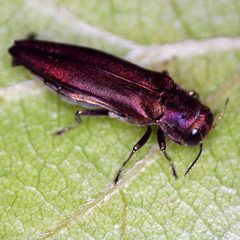
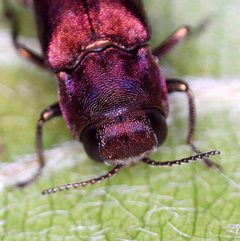
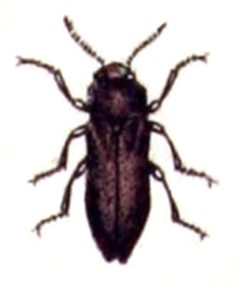
Agrilus sinuatus is a metallic wood-boring beetle in the Buprestidae, native to Europe and Northern Asia (excluding China) with introduced or established in North America. The has emerged as a significant pest of rosaceous trees in European orchards and nurseries, particularly pear, quince, and hawthorn. It was historically an occasional pest in the 19th century, became rare during the broad-spectrum era, then resurged dramatically from 1992–1997 in Germany, the Netherlands, and Belgium, with a major population explosion recorded in Hungary in 2019 causing 40–50% tree mortality in a quince orchard. The species exhibits a two-year with thermophilic tendencies, showing increased population growth following hot summers.
Pronunciation
How to pronounce Agrilus sinuatus: //ˈæɡrɪləs sɪˈnjuːətəs//
These audio files are automatically generated. While they are not always 100% accurate, they are a good starting point.
Identification
No specific diagnostic characters for distinguishing A. sinuatus from similar Agrilus are documented in available sources. Standard identification would require examination of male genitalia and comparison with revision works such as Fisher (1928) for North American specimens or European taxonomic literature for Palearctic .
Images
Habitat
Orchards and nurseries; trees in sunny locations. Field trapping studies indicate that traps placed on sunlit sides of trees at approximately 2 meters height are most effective for capture, suggesting activity is concentrated on exposed, illuminated surfaces of host plants.
Distribution
Native to Europe and Northern Asia (excluding China); occurs in North Africa to the south and the Caucasus to the east. Present in North America, though status (native or introduced) not explicitly clarified. Resurged and spread in continental Europe from 1992 onward, with notable expansions in Germany, Netherlands, Belgium, and Hungary. Major pest status in Belgium and neighboring countries. Population explosion recorded in Hajdúnánás, Hungary in 2019.
Seasonality
active from end of May to end of July. Thermophilic with growth linked to hot summer conditions.
Diet
Larvae feed on cambium and sapwood of trees, creating subcortical galleries. feed on host plant tissues.
Host Associations
- Pyrus communis - larval pear; major in orchards
- Pyrus pyraster - larval wild pear
- Crataegus spp. - larval ornamental hawthorn
- Sorbus spp. - larval rowan
- Mespilus germanica - larval medlar
- Cydonia oblonga - larval quince; site of 2019 Hungarian explosion
Life Cycle
Two-year . Females lay 30–40 on sunny sides of young tree trunks or thicker branches. Larvae develop for two years, creating characteristic downward-running sinuous subcortical galleries 50–60 cm long just below the bark, which can kill trees. Larvae mature by end of second autumn, dig pupal chamber 2–3 cm below wood surface. Before pupating, larvae chew exit hole through wood, filling it with chewing remnants without damaging bark, allowing .
Behavior
Exhibits strong behavioral response to optical features of traps—light green color is optimal attractant. are active on plants during daylight hours. Thermophilic with linked to hot summer conditions. Larval galleries characteristically run downward beneath the bark.
Ecological Role
Pest causing primary damage to rosaceous trees in orchards and nurseries. Larval galleries kill trees and create entry points for secondary through necrotic bark cracks. No native ecological role documented in available sources.
Human Relevance
Significant economic pest of pear orchards and ornamental rosaceous trees. In 2019, caused 40–50% tree mortality in a Hungarian quince orchard. Monitoring and detection are difficult due to small size, agility, and cryptic larval lifestyle. Light green and transparent sticky traps have been identified as effective monitoring tools, with light green sticky sheets being optimal.
Similar Taxa
- Other Agrilus speciesMany Agrilus are morphologically similar and require examination of male genitalia or other fine structural characters for definitive identification; Fisher (1928) remains the key revision for North American species.
- Lamprodila festivaShares similar pest status in European ornamental plantings and was studied alongside A. sinuatus in Hungarian trapping experiments; both respond optimally to light green sticky traps.
More Details
Population Resurgence
The was an occasional pest in the 19th century but became rare during the broad-spectrum era. Resurged from 1992–1997 in Germany, Netherlands, and Belgium due to favorable hot summer conditions, and has continued expanding its range and pest impact.
Trapping Efficacy
Field studies in Hungary found that light green and transparent sticky traps caught more A. sinuatus than non-sticky multifunnel traps, regardless of the larger colored surface area of funnel traps. Light green sticky sheets were optimal, though transparent sheets may reduce non-target insect captures.
Sources and further reading
- BugGuide
- Wikipedia
- GBIF taxonomy match
- iNaturalist taxon
- NCBI Taxonomy
- Catalogue of Life
- Two new species of Agrilus from Mexico | Beetles In The Bush
- Agrilus fuscipennis on Persimmon | Beetles In The Bush
- GBCT Beetle #2: Agrilus walsinghami | Beetles In The Bush
- North America’s Most Beautiful Agrilus Jewel Beetle | Beetles In The Bush
- A flower visiting jewel beetle that is not an Acmaeodera | Beetles In The Bush
- Josef Knull was wrong! | Beetles In The Bush
- The Optimal Choice of Trap Type for the Recently Spreading Jewel Beetle Pests Lamprodila festiva and Agrilus sinuatus (Coleoptera, Buprestidae)