
Agrilus ruficollis
(Fabricius, 1787)
Red-necked Cane Borer
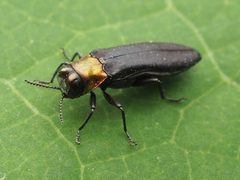
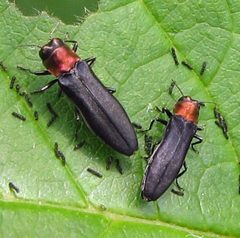
Agrilus ruficollis, commonly known as the red-necked cane borer, is a metallic wood-boring beetle in the Buprestidae. The is distributed across Europe, Northern Asia (excluding China), and North America. It is a documented pest of blackberries (Rubus spp.), with larvae tunneling through cane pith and causing cane death. are relatively large for the Agrilus and display distinctive coloration with a reddish pronotum.
Pronunciation
How to pronounce Agrilus ruficollis: /əˈɡraɪ.ləs ˌruː.fɪˈkɒl.ɪs/
These audio files are automatically generated. While they are not always 100% accurate, they are a good starting point.
Identification
Distinguished from other Agrilus by the combination of relatively large size (12–14 mm), vivid red pronotum contrasting with black , and association with Rubus . Similar in general appearance to other large, red-and-black Agrilus species such as A. fuscipennis (on persimmon) and A. vittaticollis (on serviceberry), but distinguished by host plant association and subtle morphological differences. Accurate identification may require examination of male genitalia due to the taxonomic complexity of the .
Images
Appearance
are relatively large for the Agrilus, measuring approximately 12–14 mm in length. The pronotum is vivid red, contrasting with black . The body exhibits the characteristic metallic sheen typical of jewel beetles. Like other Agrilus , the body is elongate and somewhat flattened, with short, serrate .
Habitat
Associated with blackberry canes (Rubus spp.) in agricultural and wild settings. In North America, found in regions supporting Rubus including Arkansas and other blackberry-growing areas. The species develops within living cane tissue rather than dead wood.
Distribution
Europe and Northern Asia (excluding China); North America including the United States (documented in Arkansas) and Canada (Manitoba).
Seasonality
occurs from late April to early June, with peak emergence over a two to four week period. In Arkansas studies, earliest emergence was recorded between 22–29 April, with latest completion by 8 June. Adults live approximately 13 days under laboratory conditions.
Diet
Larvae feed internally on blackberry cane pith, tunneling through living cane tissue. Specific feeding habits are not documented in available sources.
Host Associations
- Rubus spp. (blackberries) - larval Larvae develop within living canes, tunneling through pith and causing cane death. Primary documented in Arkansas blackberry production systems.
Life Cycle
Develops within living blackberry canes. Larvae tunnel through the pith of canes, causing structural damage and cane death. occurs within the cane, with emerging through exit holes. The complete timing varies annually based on temperature; in Arkansas, pupae transformed to inactive adults by late April to early May, with adult completing by early June.
Behavior
emerge from blackberry canes over a two to four week period. Larvae exhibit an internal feeding habit, tunneling through cane pith. Colored sticky traps have proven ineffective for adult detection, suggesting limited visual attraction to such cues or low mobility.
Ecological Role
In natural , role is poorly documented. In agricultural contexts, acts as a pest causing economic damage through destruction of blackberry canes. The internal larval feeding habit results in direct mortality of cane tissue.
Human Relevance
Documented pest of commercial and wild blackberries in Arkansas, causing economic losses through cane destruction. trials indicate that malathion, chlorpyrifos, and methoxychlor provide adequate control; carbaryl requires more frequent application for effective management. Colored sticky traps are ineffective for monitoring.
Similar Taxa
- Agrilus fuscipennisSimilar large size and red-and-black coloration, but associated with persimmon (Diospyros virginiana) rather than Rubus
- Agrilus vittaticollisSimilar color pattern and size, but develops in serviceberry (Amelanchier)
- Agrilus concinnusLarger and more vividly colored, associated with Hibiscus rather than Rubus
More Details
Taxonomic Note
Agrilus is one of the largest in the animal kingdom with nearly 3,000 described . Species limits within the genus are often difficult to define, and many species require examination of male genitalia for accurate identification.
Research Gaps
Detailed information beyond the Arkansas studies is limited. Larval development duration, stage, and specific feeding habits require further documentation. The full geographic range within North America and Europe is incompletely characterized.
Sources and further reading
- BugGuide
- Wikipedia
- GBIF taxonomy match
- iNaturalist taxon
- NCBI Taxonomy
- Catalogue of Life
- Agrilus fuscipennis on Persimmon | Beetles In The Bush
- A flower visiting jewel beetle that is not an Acmaeodera | Beetles In The Bush
- Oedemeridae | Beetles In The Bush
- A classic fall ‘bycid | Beetles In The Bush
- Euhagena nebraskae… again | Beetles In The Bush
- BIOLOGY AND CONTROL OF THE REDNECKED CANE BORER, AGRILUS RUFICOLLIS (F.) (COLEOPTERA: BUPRESTIDAE), ON BLACKBERRIES IN ARKANSAS1