
Agrilus concinnus
Horn, 1891
hibiscus jewel beetle
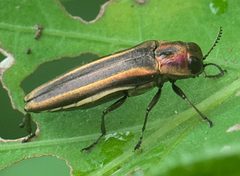
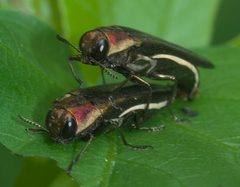
Agrilus concinnus is a large, vividly colored jewel beetle in the Buprestidae. It was formerly considered one of the rarest Agrilus in North America until researchers determined it to be a later-season species associated with living Hibiscus plants. are active from late July through early August, peaking when plants are in bloom. The species has been documented in Missouri, Kansas, Florida, Georgia, Illinois, and Texas.
Pronunciation
How to pronounce Agrilus concinnus: /ˈæɡrɪləs kənˈsɪnəs/
These audio files are automatically generated. While they are not always 100% accurate, they are a good starting point.
Identification
Distinguished from other Agrilus by its relatively large size, vivid red pronotum contrasting with black , and late-season activity period. Most other eastern North American Agrilus species are active in spring rather than late summer. Association with Hibiscus plants in wetland provides additional diagnostic context. Similar in color pattern to Agrilus fuscipennis and A. vittaticollis, but differs in host plant association and seasonal timing.
Images
Appearance
Relatively large for the Agrilus, with a vivid red pronotum and black . Considered by some entomologists to be the most beautiful in the genus in North America. The striking color combination of bright red and black distinguishes it from the typically smaller, more drab members of this hyperdiverse genus.
Habitat
Wetland supporting stands of Hibiscus , particularly sloughs, wet bottomland forests, and areas where water tends to stand. Associated with mature, natural stands of plants rather than disturbed or recently established . In Missouri, found in the southeastern lowlands region.
Distribution
North America: documented from Missouri, Kansas, Florida, Georgia, Illinois, and Texas. In Missouri, concentrated in the southeastern lowlands. The appears to be more widespread than historically recognized, but remains localized to suitable wetland with established Hibiscus .
Seasonality
active from late July through early August, with peak activity coinciding with Hibiscus bloom period. This represents an unusually late seasonal occurrence compared to most other eastern North American Agrilus , which are typically spring-active. The late seasonality contributed to its historical perception as rare.
Diet
Larvae mine the crowns and main roots of living Hibiscus plants. feed on upper leaf surfaces of plants.
Host Associations
- Hibiscus lasiocarpus - larval hairy mallow, rose mallow; primary documented in Missouri
- Hibiscus moscheutos - larval including lasiocarpos
- Hibiscus laevis - association collected on this but larval association not confirmed
Life Cycle
Larvae develop as miners in living plant tissue, specifically in the crown and main root areas of Hibiscus plants. This differs from many other Agrilus that develop in dead wood. emerge in late summer when host plants are flowering.
Behavior
perch, mate, and feed on upper leaf surfaces of plants. They are active during daylight hours and can be located by searching Hibiscus plants in peak bloom. Adults are capable of and will move between host plants.
Ecological Role
As a herbivore on Hibiscus, contributes to the natural herbivore load on wetland mallow . Larval mining in living root tissue may influence plant vigor in dense , though population levels are typically low.
Human Relevance
No significant economic impact. Of interest to coleopterists due to its striking appearance and historical rarity. The has been used as an example of how apparent rarity in insects often reflects inadequate knowledge of and rather than true scarcity.
Similar Taxa
- Agrilus fuscipennisSimilar large size and red-and-black color pattern, but associated with Diospyros virginiana (persimmon) rather than Hibiscus, and active earlier in season
- Agrilus vittaticollisSimilar color pattern with red pronotum and dark , but associated with Amelanchier (serviceberry)
- Agrilus impexusAnother large, striking Agrilus , but associated with prairie vegetation rather than wetlands and with different coloration
- Paragrilus tenuisAlso associated with Hibiscus, but much smaller (~5 mm), with different antennal structure ( received in grooves along pronotum sides), and active earlier in season
Misconceptions
Formerly considered one of the rarest Agrilus in North America based on few museum specimens and limited records. This apparent rarity was largely an artifact of its late-season activity period and specific association with living Hibiscus plants, which were not routinely sampled by collectors focused on spring-active species and dead wood .
More Details
Historical rarity and rediscovery
First collected in Missouri nearly 30 years before its formal recognition in the state, when a mating pair was found on low vegetation. Subsequent work by Ted MacRae and Gayle Nelson documented additional in Kansas and confirmed the Hibiscus association, transforming understanding of this from exceptionally rare to locally common in suitable .
Collection methodology
Best collected by beating or sweeping Hibiscus plants during peak bloom in late July to early August. Standard spring collecting methods and dead wood sampling will miss this entirely. Visual searching of upper leaf surfaces during midday can also be productive.
Sources and further reading
- BugGuide
- Wikipedia
- GBIF taxonomy match
- iNaturalist taxon
- Catalogue of Life
- Agrilus fuscipennis on Persimmon | Beetles In The Bush
- North America’s Most Beautiful Agrilus Jewel Beetle | Beetles In The Bush
- One-shot Wednesday: The “other” hibiscus jewel beetle | Beetles In The Bush
- Life at 8X—hibiscus flea beetle | Beetles In The Bush
- Art and Bob and Ted’s Excellent Adventure | Beetles In The Bush
- August | 2022 | Beetles In The Bush