
Agrilus lecontei
Saunders, 1871
Leconte's Brownsville buprestid, Common Hackberry Agrilus
Species Guides
1Agrilus lecontei is a of metallic wood-boring beetle in the Buprestidae, commonly known as Leconte's Brownsville buprestid or Common Hackberry Agrilus. The species occurs in North America and has two recognized : A. lecontei lecontei (the nominate subspecies) and A. lecontei celticola. The subspecies celticola has been associated with hackberry (Celtis spp.) in Texas and adjacent regions, though the validity of this subspecific distinction has been questioned by some researchers who note a broad transition zone across Louisiana and Mississippi.
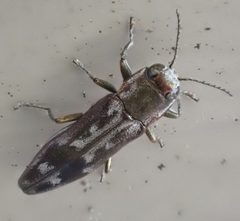
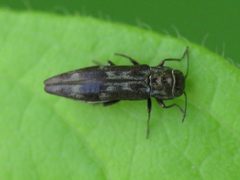
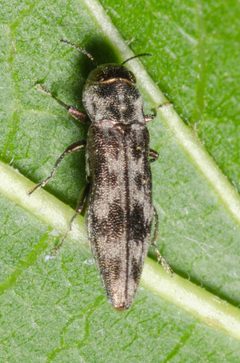
Pronunciation
How to pronounce Agrilus lecontei: /ˈæɡrɪləs ləˈkɒntaɪ/
These audio files are automatically generated. While they are not always 100% accurate, they are a good starting point.
Identification
Agrilus lecontei is part of the large and taxonomically challenging Agrilus, which contains hundreds of North American . Accurate identification typically requires examination of male genitalia and comparison with or authoritative reference collections. The A. lecontei celticola has been distinguished based on subtle morphological differences, though these characters intergrade across the species' range. are small to medium-sized metallic beetles with the characteristic buprestid body form: somewhat flattened, with short and a tapering . The species may be confused with other Agrilus species associated with Celtis, such as A. paracelti, and definitive identification should not be attempted from photographs alone.
Images
Habitat
Associated with hackberry (Celtis spp.) and related woody vegetation. The nominate occurs in southern Texas and adjacent regions, while the subspecies celticola has been recorded from Texas northward through Oklahoma and potentially into eastern states, though records become increasingly questionable where intergradation with the nominate form occurs. The inhabits riparian and upland woodland where trees occur.
Distribution
North America. The has been documented from southern Texas (type locality Brownsville area) northward through Oklahoma and potentially into the eastern United States. GBIF records indicate presence in the with confirmed observations from the United States. The A. lecontei celticola has been specifically recorded from Texas and Oklahoma, with questionable records from further east.
Diet
Larvae are wood-borers that develop in living or recently dead branches of hackberry (Celtis spp.) and potentially related . have been observed on foliage of host plants and may feed on leaf tissue or other plant surfaces, though specific adult feeding habits are poorly documented.
Host Associations
- Celtis reticulata - larval Net-veined hackberry; celticola specifically associated
- Celtis occidentalis - larval Common hackberry
- Celtis laevigata - larval Sugar hackberry
Life Cycle
Like other Agrilus , A. lecontei has a typical buprestid with laid in bark crevices or wounds on branches. Larvae bore into the wood, creating galleries under the bark and into the sapwood, where they feed and develop over one or more years. occurs in a pupal chamber within the wood, and emerge through characteristic D-shaped exit holes. The specific duration of development and number of per year have not been documented for this species.
Behavior
are and have been collected by beating branches of trees. They are likely strong fliers capable of locating host trees across the landscape. Larval galleries are packed with , distinguishing them from cerambycid borers which typically maintain open galleries.
Ecological Role
As a primary wood-borer in living or stressed hackberry branches, A. lecontei contributes to nutrient cycling and creates for secondary colonizers. The may occasionally cause noticeable branch dieback on trees, though it is not considered a major pest. It serves as prey for woodpeckers and other that excavate larval galleries.
Human Relevance
Minor economic significance. The is not a major forest or ornamental pest but may contribute to branch mortality in hackberry plantings. It is of interest to coleopterists and naturalists, with celticola being a notable target for collectors in Texas and Oklahoma. The taxonomic status of the subspecies has been debated among buprestid .
Similar Taxa
- Agrilus paraceltiAlso associated with Celtis; requires careful examination of genitalia and elytral for separation
- Agrilus limpiaeAssociated with Sapindus (soapberry); similar size and general appearance but different preference
- Agrilus ornatulusAssociated with Sapindus; may occur sympatrically and requires detailed examination for identification
Misconceptions
The A. lecontei celticola has been reported from eastern Tennessee and other locations far from the type locality, but these records are questionable given the broad intergradation zone between subspecies across Louisiana and Mississippi. Material from these areas cannot be conclusively assigned to either subspecies based on current knowledge.
More Details
Taxonomic notes
The subspecific distinction between A. lecontei lecontei and A. lecontei celticola was established by Fisher in 1928 based on material from Texas. However, subsequent collectors and researchers have noted extensive intergradation, and some question whether the distinction merits subspecific recognition. The Nelson et al. (2008) catalogue treats both as valid, but field should be cautious in assigning subspecific determinations to material from intermediate areas.
Collection records
Recent collecting trips have documented A. lecontei celticola from Gloss Mountain State Park in northwestern Oklahoma, where it was beaten from Celtis reticulata alongside the related A. paracelti. These records represent a relatively northern occurrence of the .