
Mezium americanum
(Laporte, 1840)
American spider beetle, black spider beetle
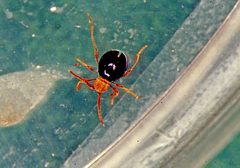
Mezium americanum, commonly known as the American or black spider beetle, is a small stored-product pest in the Ptinidae. measure 1.5–3.5 mm and are recognized by their rounded , long slender legs, and black or reddish contrasting with a dull yellow hairy body. The has a distribution and is considered in Australia. It is frequently mistaken for spiders or mites due to its distinctive body shape.
Pronunciation
How to pronounce Mezium americanum: /ˈmɛz.i.əm əˌmɛr.ɪˈkeɪ.nəm/
These audio files are automatically generated. While they are not always 100% accurate, they are a good starting point.
Identification
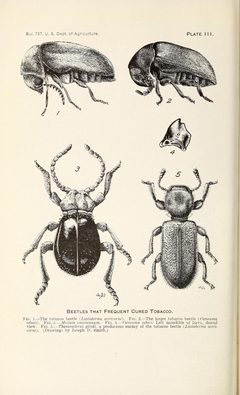
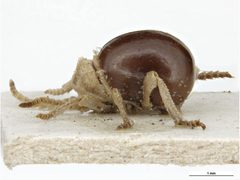
Distinguished from other spider beetles by the combination of black or reddish contrasting with a dull yellow hairy body, and the nearly cylindrical with blunt lateral projections. The long, slender legs and (pale brown to yellow) help distinguish it from spider or mite it may be mistaken for. The overall spider-like appearance—rounded and long legs—is characteristic of the Mezium.
Images
Appearance
are 1.5–3.5 mm in length. The body is dull yellow and covered with hairs. The are black or reddish. The is nearly cylindrical with blunt projections on each side. and legs are long, slender, and pale brown to yellow. Larvae are C-shaped, cream-colored with a brown .
Habitat
Associated with stored products and dry organic materials. Found in food storage facilities, warehouses, museums, and dwellings where dried goods, textiles, or animal materials are stored. Develops in dry conditions with suitable food substrates.
Distribution
distribution; present across multiple continents. Recorded as present in the Azores (Faial, São Miguel, Terceira). Considered an in Australia.
Diet
Feeds on stored animal and vegetable products including: nuts, beans, seeds, spices, cacao, powdered chocolate, cereals, meal, dried fruits, herbs, mushrooms, soup powder, fish meal, and bread. Also consumes leather, animal skins, bones, feathers, dried , silk, wool, textiles, old wood, books, dead insects and specimens, and taxidermy materials. Has been observed feeding on cayenne pepper, tobacco, and opium.
Life Cycle
Complete with , larval, pupal, and stages. Larvae are C-shaped and cream-colored with brown . Development occurs within stored food substrates or dry organic materials.
Behavior
habits typical of stored-product beetles in this group. Larvae and remain concealed within food materials or adjacent harborages.
Ecological Role
Decomposer of dry organic matter; facilitates breakdown of stored plant and animal materials. Contributes to nutrient cycling in human-associated environments.
Human Relevance
Significant pest of stored food products and museum collections. Infests pantries, food warehouses, and herbaria. Damage includes and consumption of foodstuffs, spices, and valuable organic materials including textiles, leather, books, and biological specimens.
Similar Taxa
- Other Mezium speciesShare the characteristic rounded and long legs; require examination of elytral coloration and thoracic projections for definitive identification.
- Ptinus spp.Other spider beetles with similar body forms; distinguished by specific antennal and thoracic .
- Spiders and mitesFrequently mistaken for arachnids due to rounded and long legs; distinguished by features including , , and six legs.
Misconceptions
Often mistaken for spiders or mites due to its and physical appearance; it is unequivocally a (Order Coleoptera) with hardened forewings ().
More Details
Sources and further reading
- BugGuide
- Wikipedia
- GBIF taxonomy match
- iNaturalist taxon
- Get them when they're little - Eastern tent caterpillar, Malacosoma americanum — Bug of the Week
- Hairy wanderers - Eastern tent caterpillars, Malacosoma americanum — Bug of the Week
- Time for tents - Eastern tent caterpillar, Malacosoma americanum — Bug of the Week
- Return of the tent makers - Eastern tent caterpillar, Malacosoma americanum — Bug of the Week
- The silk trail - Eastern tent caterpillar, Malacosoma americanum — Bug of the Week
- Just can't wait: Eastern tent caterpillars, Malacosoma americanum — Bug of the Week