
Mezium affine
Boieldieu, 1856
shiny spider beetle, northern spider beetle, hood spider beetle
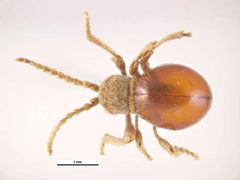
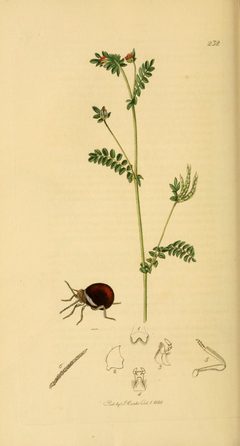
Mezium affine is a small in the Ptinidae, commonly known as the shiny or northern spider beetle. It is widely distributed across the Northern Hemisphere and has been introduced to Australia. The species is notable for its highly convex, oval body shape that gives it a spider-like appearance, and its larvae are significant pests of stored food products and organic materials.
Pronunciation
How to pronounce Mezium affine: /ˈme.zi.um əˈfiː.ne/
These audio files are automatically generated. While they are not always 100% accurate, they are a good starting point.
Identification
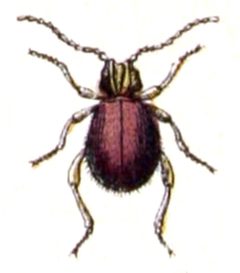
The rounded, highly convex body shape distinguishes Mezium affine from most other stored-product beetles. The combination of a dark with cream-colored appendages and the presence of scaly yellowish or gray hairs on the , , and legs provides further diagnostic characters. The spider-like appearance is the basis for its .
Images
Habitat
This is primarily associated with human environments, particularly where stored food products and organic materials are kept. It occurs in food storage facilities, warehouses, libraries, and museums. The species thrives in dry conditions and can persist in a wide range of indoor environments.
Distribution
Mezium affine occurs throughout the Northern Hemisphere, including North America, Europe, and northern Asia. It has been introduced to Australia and is present in Africa. The is in distribution due to human-mediated transport.
Seasonality
Activity patterns are not well documented, but as a stored-product pest, and larvae can be found year-round in suitable indoor environments. levels likely fluctuate based on temperature and food availability.
Diet
Larvae feed on a remarkably broad range of materials including grain, spices, fish meal, dog biscuits, dried fruit, dried meat, dried mushrooms, seeds, wool, hair, feathers, skins, book bindings, dead insects, , and sugar. This feeding habit allows the to thrive in diverse environments.
Life Cycle
The includes , larval, pupal, and stages. Larvae are the primary feeding and damaging stage. Development occurs within infested materials, with larvae feeding internally or within accumulated debris.
Behavior
Larvae are known to infest stored food and other products, causing damage through feeding. The can be found in libraries and museums where it may damage specimens and collections. are relatively inconspicuous due to their small size and cryptic habits.
Ecological Role
As a stored-product pest, Mezium affine plays a role in decomposition of organic materials in human environments. It is not known to have significant ecological roles in natural .
Human Relevance
This is a significant pest of stored food products and organic materials. It can cause economic damage in food storage facilities, warehouses, libraries, and museums. Its broad dietary range makes it particularly difficult to control in settings with diverse organic materials.