
Thorictini
Erichson, 1846
Genus Guides
2- Thorictodes
- Thylodrias(odd beetle)
Thorictini is a tribe of carpet beetles ( Dermestidae) established by Erichson in 1846. Members of this tribe are small, compact beetles adapted to specialized microhabitats. The tribe is relatively -poor compared to other dermestid tribes and includes such as Thorictus. These beetles are primarily known from the Palearctic and Afrotropical regions.
Pronunciation
How to pronounce Thorictini: /ˌθɒrɪkˈtaɪnaɪ/
These audio files are automatically generated. While they are not always 100% accurate, they are a good starting point.
Identification
Thorictini can be distinguished from other Dermestidae tribes by the combination of: short, 3-segmented antennal club; 5-segmented in both sexes (unlike some tribes with 4-segmented male tarsi); and the often exposed abdominal tergites due to abbreviated . The pronotal shape—narrowed anteriorly with modified lateral margins—separates them from the more generalized Megatomini. Thorictus and related lack the strongly developed posterolateral pronotal lobes found in Anthrenini.
Images
Appearance
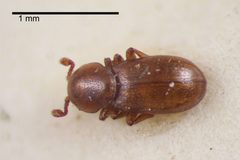
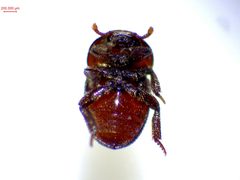
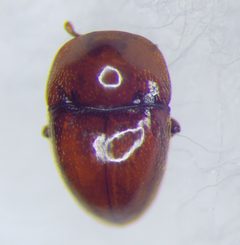
Small, oval to elongate-oval beetles with compact bodies. are short with a distinct 3-segmented club. The pronotum is often narrowed anteriorly and may have lateral margins that are explanate or modified. are typically short, exposing one or more abdominal tergites. Body surface is frequently covered with or setae, sometimes forming distinct color patterns. are 5-5-5 in both sexes.
Habitat
Specialized microhabitats including nests (myrmecophily), rodent burrows, and accumulations of organic debris. Some inhabit caves and subterranean environments. The association with ant colonies is particularly notable in the Thorictus.
Distribution
Primarily Palearctic and Afrotropical regions, with highest diversity in the Mediterranean basin, Middle East, and sub-Saharan Africa. Some extend into the Oriental region. The distribution is discontinuous, reflecting specialized requirements.
Seasonality
Activity patterns vary by and . in -associated species may be found year-round within colonies. Free-living species are most commonly encountered in spring and summer.
Host Associations
- Formicidae - myrmecophileMany Thorictus are obligate or facultative in nests, particularly those of Cataglyphis and related desert ants.
- Rodentia - commensalSome inhabit rodent burrows, feeding on organic debris and nest materials.
Behavior
Myrmecophilous exhibit behavioral adaptations for life in colonies, including mimicry of ant cuticular hydrocarbons and appeasement to avoid aggression. Some species are known to be carried by host ants (). When disturbed, individuals may contract appendages and remain motionless ().
Ecological Role
Decomposers in specialized microhabitats; contribute to nutrient cycling in nests and subterranean environments. Myrmecophilous may also serve as food sources for ants or their .
Human Relevance
Limited direct impact. Some occasionally found in stored products or organic debris in human structures, but not considered significant pests. Of interest to entomologists studying myrmecophily and - evolutionary relationships.
Similar Taxa
- MegatominiAlso in Dermestinae, but Megatomini have more generalized body form, longer covering the completely, and often 4-segmented male .
- AnthreniniShare abbreviated in some , but Anthrenini have strongly developed posterolateral pronotal lobes and different antennal club structure; includes common carpet beetles (Anthrenus).
- DermestiniLarger, more robust beetles with complete and different pronotal structure; includes larder beetles (Dermestes) and hide beetles.
More Details
Myrmecophily
The tribe Thorictini is notable within Dermestidae for the high frequency of myrmecophilous , particularly in the Thorictus. This represents one of the most extensive radiations of -associated beetles in the , with species specialized for life in nests of desert-dwelling ants.