
Reesa vespulae
(Milliron, 1939)
Undertaker Carpet Beetle
Reesa vespulae is a small parthenogenetic dermestid native to North America that has become a pest of heritage collections and stored products. The spreads globally through human commerce and can establish from a single female due to obligate . It poses significant threats to museums, herbaria, and entomological collections, with larvae showing particular preference for Coleoptera and Lepidoptera specimens.
Pronunciation
How to pronounce Reesa vespulae: //ˈɹiːsə vɛsˈpjuːli//
These audio files are automatically generated. While they are not always 100% accurate, they are a good starting point.
Identification
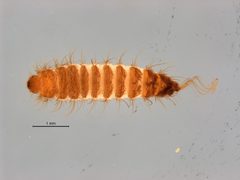
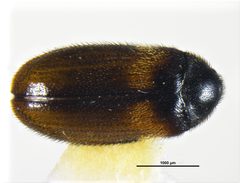
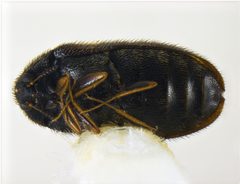
Distinguished from other dermestid pests by its elongated rather than rounded body shape, the orange-oblique band on the below the shoulder, and yellow-brown leg coloration. The combination of yellow elytral fasciae against a dark brown background separates it from Attagenus (uniformly dark) and most Anthrenus species (more rounded with variable patterning). The four-segmented brown antennal club differs from some related . All specimens are female; no males have been found.
Images
Appearance
Small measuring 2.5–4 mm in length with an elongated, somewhat flattened body. Coloration is black-brown overall, covered with large brown setae except for distinct yellow elytral fasciae. are brown with an orange-oblique band below the shoulder. Legs are yellow-brown, with tibiae and matching this coloration. have articles 2–6 yellow-brown, terminating in a brown four-segmented club. Body shape is more elongate than the rounded form typical of Anthrenus carpet beetles.
Habitat
Indoor environments associated with human structures: museums, historic houses, libraries, art galleries, store rooms, food warehouses, and private dwellings. Specific microhabitats include accumulations of fluff and dust beneath furniture, spaces under display cases, dead birds in roof areas, and nests on building exteriors. Development occurs in dry, undisturbed locations with access to proteinaceous materials.
Distribution
Native to North America, originally described from Minnesota. Introduced to Europe beginning in the 1950s (first UK record 1970s), New Zealand by 1942, and subsequently spread to Australia, South America, and North Africa. Now established throughout much of Europe with increasing detection in museum environments since 2014.
Seasonality
activity occurs year-round in heated indoor environments. Trapping data shows adults and larvae more frequently detected during active . No true seasonal dormancy; development rate depends entirely on temperature with slower progression in cooler conditions.
Diet
Larvae feed on dried animal and plant materials including hides, furs, leather, wool, dried plants, and stored grain or cereal products. In museum collections, larvae show marked preference for Coleoptera and Lepidoptera specimens over other zoological materials.
Life Cycle
Development is temperature-dependent: 1–1.5 years at 25°C, 2 years at 23°C, and 3 years at 15–21°C. No development occurs below 13°C. hatch after approximately 3 weeks at 18°C. live 6–14 days at room temperature. Females begin oviposition after 2–3 days, producing approximately 24 eggs. Obligate allows establishment from a single individual.
Behavior
Larvae range widely in search of food when is high. are attracted to light and found against windows in morning. Parthenogenetic enables rapid of new sites without mating. Typically detected as adults in small , but larvae predominate where are dense.
Ecological Role
Pest in anthropogenic environments. Damages natural history collections, herbaria, and stored food products. Serves as an indicator of inadequate environmental management in heritage institutions.
Human Relevance
Significant economic pest of museum and heritage collections, causing irreversible damage to irreplaceable scientific and cultural specimens. Subject to monitoring and control programs in Austrian museums, where found in approximately 30% of monitored buildings. Control relies on freezing or anoxia treatments; use restricted in EU. facilitates spread through international trade and travel.
Similar Taxa
- Attagenus unicolor (black carpet beetle)Uniformly dark coloration without yellow elytral fasciae; more rounded body shape
- Anthrenus spp. (museum carpet beetles)Rounded body form with variable patterning but lacking the orange-oblique shoulder band and elongated shape of Reesa
- Trogoderma variabile (warehouse beetle)Larger size with different elytral patterning; males present in
More Details
Parthenogenesis
Reesa vespulae exhibits obligate with no males known. This reproductive mode provides significant advantage, as any female can establish a new without mating. All documented specimens across native and introduced ranges have been female.
Taxonomic history
Originally described in Eurhopalus; the 2022 phylogenetic revision of Dermestidae by Zhou et al. clarified relationships within Attageninae. The epithet 'vespulae' refers to association with nests (Vespula), a documented .
Detection challenges
Low densities in museums often result in detection of only isolated , making source identification difficult. Larval development sites may be distant from trap locations. The ' slow development at typical indoor temperatures (15–21°C) allows populations to persist undetected for years.