
Reesa
Beal, 1967
Species Guides
1- Reesa vespulae(Undertaker Carpet Beetle)
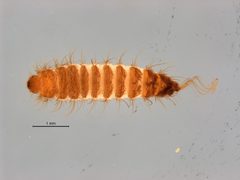
Reesa is a of skin beetles (Dermestidae) established by Beal in 1967. The sole , Reesa vespulae, is a small native to North America that has become a widespread pest of heritage collections and stored products. The species is obligately parthenogenetic—only females are known—and can establish from a single individual. Genetic research suggests close relationship to Trogoderma angustum and South American species, with some authors proposing merger into Eurhopalus, though this remains disputed.
Pronunciation
How to pronounce Reesa: /ˈɹiːsə/
These audio files are automatically generated. While they are not always 100% accurate, they are a good starting point.
Identification
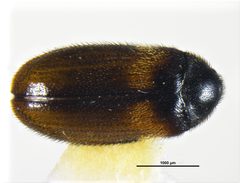
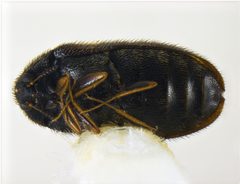
The single Reesa vespulae can be recognized by two reddish bands on the , black setae, and with four-segmented clubs. It is a small , 2.5–4 mm in length. No males have been observed; the absence of males in collections is itself a diagnostic indicator. Similar dermestid (Attagenus, Trogoderma, Anthrenus) differ in antennal club segmentation, elytral pattern, or presence of both sexes.
Images
Habitat
Primarily associated with human-built environments: museums, historic houses, libraries, art galleries, store rooms, and food warehouses. Also occurs in domestic dwellings. Hidden include fluff and dust under furniture, spaces beneath display cases, roof areas with dead birds, and external nests. In Lyon, France, specimens were found against windows in morning light.
Distribution
Native to the Nearctic region, originally described from Minnesota nests. Introduced to Europe mid-20th century (first New Zealand record 1942, Europe through 1950s, UK 1970s). Currently established throughout much of Europe, Australia, New Zealand, South America, and North Africa. Documented locations include Austria, UK, Germany, Czech Republic, Bulgaria, Finland, Norway, Sweden, France, and New Zealand.
Seasonality
live 6–14 days at room temperature. In Lyon, France, adults were collected May–July. No clear seasonal peak documented beyond adult longevity constraints.
Diet
Larvae and feed on dried animal products: hides, leather, skin, wool, fur; stored grain and cereal products; dried plants including herbarium specimens; and zoological collections with documented preference for Coleoptera and Lepidoptera specimens. Also recorded from dead birds in roof spaces and materials associated with Hymenoptera.
Life Cycle
Obligately parthenogenetic; no males known. hatch after approximately 3 weeks at 18°C. Larval development highly temperature-dependent: 1–1.5 years at 25°C, 2 years at 23°C, 3 years at 15–21°C; no development below 13°C. emerge, begin oviposition after 2–3 days, and lay approximately 24 eggs per female. Long time means small temperature increases could substantially increase growth rates.
Behavior
Larvae range more widely for food during heavy , as evidenced by higher trap catches. Small typically detected as ; larval forms indicate established, high- infestations. Can persist undetected in hidden microhabitats (dust accumulations, case undersides) that serve as for re-infestation. Capable of breeding outside museums in nests.
Ecological Role
Significant pest in heritage environments; enables rapid and persistence from minimal pressure. Represents a case study in biological invasion facilitated by reproductive mode. Contributes to broader pattern of increasing dermestid pest problems in museum and archival settings.
Human Relevance
Major museum pest causing damage to irreplaceable scientific and cultural collections. Infests 3–30% of heritage buildings depending on region. Control methods include freezing, anoxia, and ; is ineffective due to . Long larval development complicates detection and management. Also occurs in food storage facilities and domestic settings.
Similar Taxa
- TrogodermaClosely related per genetic research; some authors have merged Reesa into Trogoderma or related . Differs in reproductive mode (Trogoderma has bisexual ) and specific elytral patterns.
- AttagenusSimilar as stored product pest; differs in antennal structure and presence of both sexes.
- AnthrenusComparable damage to collections; differs in elytral coloration patterns and .
More Details
Taxonomic Uncertainty
Zhou et al. (2022) genetic research revealed close relationship to Trogoderma angustum and South American including Sodaliotoma. These authors proposed reclassification as Eurhopalus vespulae, noting many species previously in Trogoderma belong in Eurhopalus. This change is not yet universally accepted; Reesa vespulae remains the prevalent usage.
Parthenogenesis
One of few confirmed parthenogenetic dermestids (per Crowson 1981). This trait is central to its invasion success: a single female can establish a persistent , and no methods are effective for control.
Detection Challenges
Long, temperature-dependent larval development (up to 3 years) means can remain cryptic. presence alone may indicate small, recent introduction; larval detection signals established, damaging . Museum monitoring programs often under-detect this .