
Psoa
Herbst, 1797
Species Guides
2- Psoa maculata(horned powder-post beetle)
- Psoa quadrisignata(horned powder-post beetle)
Psoa is a of bostrichid beetles comprising approximately five described . Members are distributed across Africa, Europe, Asia, North America, and South America. The genus was established by Herbst in 1797 with Psoa viennensis as the type species. Species in this genus are wood-boring beetles associated with dead or dying wood.
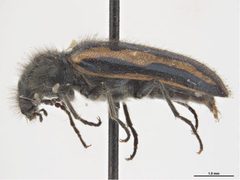
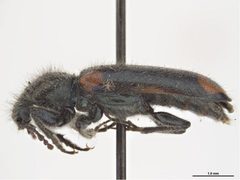
Pronunciation
How to pronounce Psoa: /ˈpsoʊ.ɑː/
These audio files are automatically generated. While they are not always 100% accurate, they are a good starting point.
Images
Habitat
Associated with dead or dying wood; specific microhabitat preferences vary by .
Distribution
Africa, Europe, Northern Asia, North America, Central America, and South America. Individual have more restricted ranges: Psoa dubia occurs in Africa, Europe, and Northern Asia; Psoa maculata in North America; Psoa quadrinotata in South America; Psoa quadrisignata in Central and North America; and Psoa viennensis in Europe and Northern Asia.
Behavior
Wood-boring; larvae tunnel in wood.
Ecological Role
Decomposer of dead wood.
Human Relevance
Some may infest seasoned timber or wooden structures, though economic impact is generally minor compared to other bostrichid pests.
Similar Taxa
- LyctusBoth are bostrichid beetles with wood-boring larvae; Lyctus are powderpost beetles with more uniformly cylindrical bodies and reduced elytral sculpturing, whereas Psoa species typically have distinct elytral markings and different antennal club structure.
- DinoderusAnother bostrichid with wood-boring habits; Dinoderus are generally smaller with more pronounced antennal clubs and different pronotal shapes.
Sources and further reading
- BugGuide
- Wikipedia
- GBIF taxonomy match
- iNaturalist taxon
- Catalogue of Life
- Observations on the Biology of Psoa maculata Leconte (Psoidae)
- Research on fault location algorithm of TPSS based on PSOA
- PSOA-LSTM: a hybrid attention-based LSTM model optimized by particle swarm optimization for accurate lung cancer incidence forecasting in China (1990-2021).