
Scobicia chevrieri
(Villa & Villa, 1835)
horned powder-post beetle
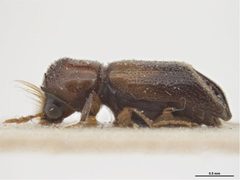
Scobicia chevrieri is a small wood-boring in the Bostrichidae. measure 3.3–4.5 mm in length and 1.2–1.5 mm in width. The is a pest of cut and stored wood, creating galleries that cause severe interior deterioration of branches. It has been recorded across the Mediterranean region, North Africa, the Middle East, and introduced to North America.
Pronunciation
How to pronounce Scobicia chevrieri: /skɔˈbɪʃi.a ˈʃɛvɹi.eɪ/
These audio files are automatically generated. While they are not always 100% accurate, they are a good starting point.
Identification
are distinguished by their small size (3.3–4.5 mm long, 1.2–1.5 mm wide) and the presence of a horn-like on the pronotum, characteristic of the 'horned powder-post beetles.' Tunnel openings approximately 1.5 mm in diameter on wood surfaces indicate presence. Identification requires examination of pronotal and elytral ; keys by Lesne (1900), Reitter (1911), and Fisher (1950) have been used for confirmation.
Images
Habitat
Cut and stored wooden branches (3–18 cm diameter) of ornamental trees, stored outdoors for at least one year; dead branches of various hardwood trees. Living trees are not infested.
Distribution
Native to: Italy (Alps, Tyrol, Sardinia, Sicily), French Mediterranean coast, Corsica, Spain (Málaga, Seville, Córdoba), Morocco, Tunisia, Algeria, Israel, Lebanon, Syria, Caucasus, Crimea, Cyprus, Greece (Attika). Introduced to North America. GBIF records indicate presence in Africa, Europe and Northern Asia (excluding China), and North America.
Diet
Interior wood tissue of dead or cut branches; creates extensive galleries causing almost complete deterioration of wood interior.
Host Associations
- Brachychiton acerifolium - new record; more severe than on B. diversifolium
- Brachychiton diversifolium - new record
- Ficus sp. - fig
- Morus sp. - mulberry
- Quercus ilex - green oak
- Quercus robur - English oak
- Quercus coccifera - evergreen oak
- Laurus nobilis - laurel
- Pistacia lentiscus - mastic-tree
- Betula sp. - birch
- Vitis labrusca - fox grape
- Punica granatum - pomegranate
- Castanea sp. - chestnut
- Eucalyptus spp. - gum-tree
Behavior
Creates tunnel openings approximately 1.5 mm in diameter on exterior of infested branches. Constructs numerous galleries that cause almost complete interior deterioration of wood. occurs exclusively after felling; living trees are not attacked. Shows preference for Brachychiton acerifolium over B. diversifolium when both are available.
Ecological Role
Decomposer of dead and cut wood; pest of stored timber and wooden articles.
Human Relevance
Pest of ornamental tree branches stored for timber or decorative use. Has been intercepted in bamboo articles imported to Greece from Hong Kong and the Philippines, suggesting potential for international spread via wood products.
Similar Taxa
- Rhysopertha dominicaAlso in Bostrichidae, but distinguished by being a rather than wood-borer; attacks stored wheat rather than timber
- Dinoderus minutusAlso in Bostrichidae, but associated with bamboo rather than hardwood branches
- Dinoderus brevisAlso in Bostrichidae, but associated with bamboo rather than hardwood branches