
Gyrinus picipes
Aubé, 1838
whirligig beetle
Gyrinus picipes is a of whirligig beetle in the Gyrinidae. It is found in North America, with records from multiple Canadian provinces including Alberta, British Columbia, and Manitoba. Whirligig beetles in this are characterized by their distinctive habit of swimming in erratic, circling patterns on the water surface.
Pronunciation
How to pronounce Gyrinus picipes: //dʒɪˈraɪnəs ˈpɪsɪˌpiːz//
These audio files are automatically generated. While they are not always 100% accurate, they are a good starting point.
Identification
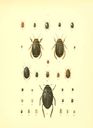
Members of the Gyrinus can be distinguished from the other North American whirligig beetle genus Dineutus by their smaller size and exposed scutellum. Dineutus are larger (approximately 12 mm) and have a hidden scutellum with rounded elytral apices. Specific identification of G. picipes likely requires examination of coloration or other subtle morphological features.
Images
Habitat
Aquatic environments, specifically the surface of freshwater bodies. Whirligig beetles in the Gyrinidae inhabit the surface film of lakes, ponds, streams, and rivers, where they form or 'rafts' in sheltered pools near shore.
Distribution
North America. Documented from Canadian provinces including Alberta, British Columbia, and Manitoba. The ' range extends across the continent, though specific southern limits are not well documented in available sources.
Behavior
Forms surface or 'rafts' on calm water. These aggregations function in detection through increased vigilance from multiple sets of , and may serve as aposematic signals warning fish of chemical defenses produced in paired pygidial glands.
Ecological Role
or scavenger on water surface. Whirligig beetles feed on organisms or scavenge debris at the air-water interface. Their pygidial gland secretions contain noxious volatile substances that deter fish .
Similar Taxa
- Dineutus spp.The other of North American whirligig beetles. Dineutus are larger (~12 mm versus smaller Gyrinus), have hidden scutellum, and rounded elytral apices. Dineutus species also have distinctive leg coloration (e.g., orange legs in D. emarginatus versus dark legs in D. ciliatus) that aids identification.
More Details
Taxonomic note
The specific epithet 'picipes' (from Latin 'piceus' meaning pitch-black or tar-like, and 'pes' meaning foot) likely refers to dark leg coloration, a trait used to distinguish similar in the related Dineutus.
Observation rarity
As of available records, iNaturalist documents only 6 observations of this , suggesting it may be underreported, difficult to identify to species level from photographs, or genuinely uncommon relative to more frequently observed whirligig beetles.