
Gyrinus gibber
LeConte, 1868
whirligig beetle
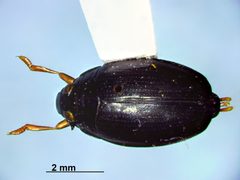
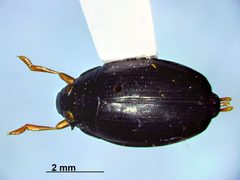
Gyrinus gibber is a of whirligig beetle ( Gyrinidae) described by LeConte in 1868. Like other members of its family, it inhabits the water surface of freshwater . The species occurs in North America, with records from Canada (New Brunswick, Ontario, Québec) and the United States. Whirligig beetles are named for their characteristic rapid, circling swimming patterns on water surfaces.
Pronunciation
How to pronounce Gyrinus gibber: /dʒaɪˈraɪnəs ˈdʒɪbər/
These audio files are automatically generated. While they are not always 100% accurate, they are a good starting point.
Identification
Gyrinus are small to medium-sized whirligig beetles, generally smaller than the related Dineutus. Gyrinus gibber can be distinguished from Dineutus by its smaller size and exposed scutellum (in Dineutus, the scutellum is hidden). Species-level identification within Gyrinus requires examination of characters and male genitalia. The genus Gyrinus is one of only two genera of whirligig beetles occurring in eastern North America.
Images
Habitat
Freshwater aquatic , including rivers, streams, and ponds with clear, slow-moving or still water. Observations indicate preference for sheltered pools near shorelines with gravel or rocky substrates.
Distribution
North America. Documented from Canada: New Brunswick, Ontario, Québec. Present in the United States, though specific state records are not detailed in available sources.
Behavior
Forms or 'rafts' on the water surface, a common to whirligig beetles. These rafts function in detection through increased vigilance from multiple individuals. Members of the Gyrinidae produce defensive chemicals from paired pygidial glands, and raft formation may serve as an aposematic signal to predators such as fish.
Ecological Role
Surface-dwelling and scavenger in freshwater . Occupies the air-water interface, feeding on organisms trapped in the surface film and scavenging debris.
Similar Taxa
- DineutusLarger size (often 10-12 mm vs. smaller Gyrinus), hidden scutellum, and rounded elytral apices distinguish Dineutus from Gyrinus. Dineutus also form surface rafts but are visibly larger in mixed .
- Other Gyrinus species-level identification within Gyrinus requires detailed examination of and male genitalia; external features alone are generally insufficient.
More Details
Taxonomic Note
Gyrinus gibber was described by John Lawrence LeConte in 1868. The specific epithet 'gibber' refers to a hump or , likely describing a morphological feature of the .
Sources and further reading
- BugGuide
- Wikipedia
- GBIF taxonomy match
- iNaturalist taxon
- NCBI Taxonomy
- Gyrinidae | Beetles In The Bush
- Look but do not touch: puss caterpillar, Megalopyge opercularis; White flannel moth, Norape ovina; Io moth, Automeris io; buck moth Hemileuca spp.; and hag moth, Phobetron pithecium — Bug of the Week
- Bichos Argentinos #5 – Cyrtocoris egeris | Beetles In The Bush
- Gromphadorina portentosa | Beetles In The Bush