
Thermonectus marmoratus
(Gray, 1831)
sunburst diving beetle, yellow-spotted diving beetle, spotted diving beetle
Thermonectus marmoratus is a small, brightly colored diving native to southwestern North America and Mexico. are distinguished by black with yellow or golden spots and possess specialized adaptations for aquatic life, including air bubble storage beneath the wings for extended underwater respiration. The is notable for its aposematic coloration warning of chemical defenses, and for the extraordinary visual system of its larvae—featuring bifocal lenses with dual retinas that constitute the first recorded instance of bifocal vision in the animal kingdom. Larvae are active with complex stemmata capable of near and far vision, polarization sensitivity, and behavioral scanning mechanisms to extend their narrow visual fields.
Pronunciation
How to pronounce Thermonectus marmoratus: //ˌθɜːrmoʊˈnɛktəs ˌmɑːrmɔːˈreɪtəs//
These audio files are automatically generated. While they are not always 100% accurate, they are a good starting point.
Identification
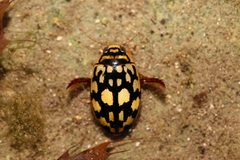
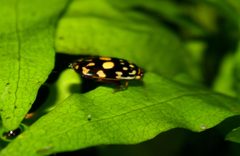
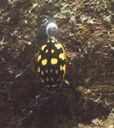
are readily identified by the combination of small size (under 15 mm), black body with contrasting yellow or golden spots, and aquatic . The spotted pattern distinguishes it from uniformly colored diving beetles. Males can be confirmed by the presence of foreleg suction disks. Similar in the Thermonectus may overlap in range but can be distinguished by spot pattern and size; precise identification may require examination of male genitalia. Larvae are distinguished by their six stemmata with two forming conspicuous long tubes, and their characteristic dorso- pivoting when hunting.
Images
Habitat
Inhabits slow-moving freshwater , particularly shallow, temporary or intermittent pools and creeks (arroyos) with minimal aquatic vegetation. Strongly associated with arid and semi-arid regions where water sources are ephemeral. and larvae are aquatic; occurs on land in moist substrates near water edges.
Distribution
Native to southwestern North America and Mexico. In the United States, recorded from extreme southern California (primarily Peninsular Ranges), southern Utah, Arizona, New Mexico, and Texas (first recorded 1996). Mexican distribution extends the range southward through appropriate arid and semi-arid .
Seasonality
Active year-round in permanent water sources; in temporary , activity is tied to presence of water. are capable of and will disperse to new water sources when habitats dry. Specific seasonal peaks in activity are not well documented but likely correspond to monsoon patterns in desert regions.
Diet
and scavengers of small aquatic animals. Prey includes —especially other aquatic insects, snails, and mosquito larvae and pupae—and small vertebrates including young fish and tadpoles. Preferentially feed on small, dead soft-bodied animals when available. In captivity, accept flake fish food and live crickets. Larvae prey primarily on mosquito larvae and other aquatic invertebrates.
Life Cycle
Complete with , larva, pupa, and stages. Eggs are 3.5–4 mm, initially white and opaque, becoming translucent during development with visible externally around one-third of development and discernible near halfway. Larvae are aquatic and pass through multiple instars. occurs on land. Development from egg to adult can occur in 28 days under favorable conditions.
Behavior
carry air bubbles beneath their wings to extend underwater time, a analogous to scuba diving. When hunting, larvae perform distinctive dorso- body pivots prior to prey capture, behaviorally extending their vertical visual field from approximately 2° to 50°. This scanning behavior occurs at a characteristic distance from prey. Adults fly to locate new water sources when dry. Adults and larvae have been observed swarming prey items and feeding en masse.
Ecological Role
in aquatic , controlling of mosquito larvae and other aquatic . Contributes to nutrient cycling through scavenging. Serves as prey for aquatic and terrestrial predators including fish, birds, and other insects. The aposematic coloration and chemical defenses suggest established predator-prey relationships with visually hunting predators.
Human Relevance
Occasionally displayed in zoos and aquariums due to bright coloration, sometimes exhibited with Abedus herberti and other aquatic beetles. Consumes mosquito larvae, providing potential value. Subject of extensive scientific research due to the unique bifocal visual system of larvae, which has advanced understanding of evolution and function. Not known to be economically significant as pest or beneficial in agriculture.
Similar Taxa
- Abedus herbertiCo-occurs in the wild and in zoo displays; distinguished by different body shape and color pattern, and by male forelegs modified into grasping organs rather than suction disks.
- Other Thermonectus species members share aquatic habits and diving ; require examination of spot pattern, size, and male genitalia for definitive separation.
More Details
Chemical defense
The yellow spots on black background constitute aposematic (warning) coloration. When threatened, eject a milky chemical from glands behind the , composed primarily of steroid cybisterone and mirasorvone. Mirasorvone has been hypothesized to function specifically as a fish deterrent.
Visual system—larval bifocal eyes
The larval principal E1 and E2 each contain a bifocal asymmetric lens with different protein composition in center versus edges, paired with two retinas at substantially different focal planes. This optical arrangement allows simultaneous formation of two images, enabling unilateral range finding and efficient prey capture across distances. E1 is optimized for far vision, E2 for near vision. The system represents the first documented case of bifocal vision in the animal kingdom.
Visual system—polarization sensitivity
Larval retinas contain three photoreceptor types (T1, T2, T3) with microvillar orientations conferring sensitivity to vertical (T1, T3) or horizontal (T2) polarized light. This polarization sensitivity likely functions in finding water after hatching, locating shore before , and enhancing prey visibility by filtering horizontally polarized haze or detecting polarization features of prey.
Visual system—spectral sensitivity
Larval express three opsin genes: TmLW (long-wavelength) in retinas, TmUV I and TmUV II in retinas. Electrophysiological recordings confirm photoreceptor sensitivities peaking at approximately 374–375 nm (UV, proximal ) and 520–540 nm with secondary 340–360 nm peak (green, distal retina). This spectral organization supports the bifocal range-finding function.
Sources and further reading
- BugGuide
- Wikipedia
- GBIF taxonomy match
- iNaturalist taxon
- NCBI Taxonomy
- Catalogue of Life
- Bug Eric: Review: Diving Beetles of the World
- Bug Eric: Beetles from Bones
- Bug Eric: What's in Dat Scat?
- Bug Eric: More Beetles from Bones
- Spectral sensitivity of the principal eyes of sunburst diving beetle, Thermonectus marmoratus (Coleoptera: Dytiscidae), larvae
- Spatial distribution of opsin-encoding mRNAs in the tiered larval retinas of the sunburst diving beetle Thermonectus marmoratus (Coleoptera: Dytiscidae)
- Scanning behavior by larvae of the predacious diving beetle, Thermonectus marmoratus (Coleoptera: Dytiscidae) enlarges visual field prior to prey capture
- Electrophysiological evidence for polarization sensitivity in the camera-type eyes of the aquatic predacious insect larva,Thermonectus marmoratus(Coleoptera: Dytiscidae)
- Multitasking in an eye: How the unusual organization of the principal larval eyes of Thermonectus marmoratus allows for far and near vision and might aid in depth perception