
Nebria brevicollis
(Fabricius, 1792)
European Gazelle Beetle, Short-collared Gazelle Beetle
Nebria brevicollis is a ground beetle native to Europe and the Near East that has been introduced to western North America. It is a , opportunistic with a flexible involving -controlled reproductive . The exhibits remarkable breadth, from sea level to alpine zones, and shows phenotypic plasticity in muscle development based on larval nutrition. Its rapid expansion in the Pacific Northwest has raised questions about potential ecological impacts on native carabid .
Pronunciation
How to pronounce Nebria brevicollis: /ˈnɛbriə ˌbrɛvɪˈkɒlɪs/
These audio files are automatically generated. While they are not always 100% accurate, they are a good starting point.
Identification
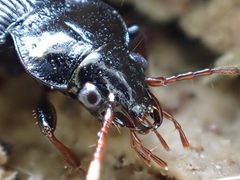
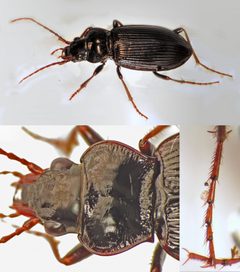
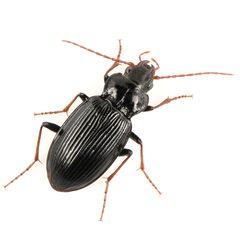
measure 10–14 mm in length with a dark brown to black body and reddish-brown tibiae, , palpi, and . The pronotum bears two lateral setae on each side and is densely punctate across its base. Most individuals have reduced, non-functional muscles; only well-fed larvae develop functional flight muscles in adults. No has been documented.
Images
Habitat
Primary is shaded leaf litter in deciduous forests. Also occurs in disturbed habitats including parks, gardens, agricultural lands, and coastal military ranges. In North America, found from sea level to over 1200 m elevation in mountains, including old-growth forest stands. Unlike , avoids moist areas.
Distribution
Native to Europe (absent only from Azores, Canary Islands, Channel Islands, Franz Josef Land, Gibraltar, Madeira, Malta, Monaco, North Aegean Islands, Novaya Zemlya, San Marino, Selvagens Islands, Svalbard and Jan Mayen, Vatican City) and the Near East. Introduced to western Oregon (first reported 2008), Washington, northern California, and southern British Columbia, Canada.
Seasonality
Most abundant October–December and January through mid-May. active year-round with peak activity June–August. Reproductive occurs July–August lasting 5–6 weeks. Breeding occurs in fall for diapausing individuals; continuous breeding possible under long-day conditions (>15 hours ).
Diet
Opportunistic and omnivore. Preys on small arthropods (<4 mm), including Collembola, Diptera, earthworms, mites, spiders, and other beetles (larval and stages). Also consumes mollusks including slugs (Deroceras reticulatum), with stronger preference for injured or dead individuals due to reduced handling time. Small studies indicate occasional consumption of soil fungi.
Life Cycle
emerge from pupae with muscles that either develop or become arrested depending on larval food availability. Well-fed larvae produce dispersers with functional flight muscles; food restriction produces flightless adults. Following , adults undergo intense feeding (prediapause), then enter reproductive triggered by short day lengths (≤15 hours) or fat content thresholds. Post-diapause breeding begins in fall. hatch in approximately 17 days. Female breeding lifespan averages 27 days. Larvae are active late winter to early spring.
Behavior
forager. Foraging includes up and down grass stalks and wandering over vegetation, enabling both horizontal and vertical prey search. Exhibits associative learning ability, though not correlated with exploratory . Aggregates in groups up to 80 individuals under stones or logs during . Exploratory behavior varies with urbanization level; individuals from urban areas show increased exploration.
Ecological Role
Ground-dwelling controlling of small . Serves as bioindicator for environmental impacts of urbanization, pollution, and land management practices. Potential competitor with native carabids including Pterostichus algidus; abundance increases may negatively impact other carabid . Documented predator of endangered Fender's blue . Preyed upon by fungus Erynia nebriae.
Human Relevance
Used as bioindicator for soil quality and environmental pollution monitoring. Rapid range expansion in North America characteristic of , though ecological impacts remain under investigation. Subject of citizen science surveys and ecological research on loss evolution, personality-cognition relationships, and climate .
Similar Taxa
- Pterostichus algidusSimilar diet and breeding practices; competition for food hypothesized
- Other Nebria speciesN. brevicollis distinguished by avoidance of moist areas, unlike
Sources and further reading
- BugGuide
- Wikipedia
- GBIF taxonomy match
- iNaturalist taxon
- NCBI Taxonomy
- Meloidae Holdings | Entomology Research Museum
- Springing into action – oil beetles and citizen science! - Buglife Blog - Buglife
- An Unconventional Home for the Gold-fringed Mason Bee - Buglife Blog - Buglife
- Cartref Anghonfensiynol i’r Saerwenynen Eddi Aur - Buglife Blog - Buglife
- Blog - Page 5 of 33 - Buglife
- Diapause and Reproduction in Nebria brevicollis (F.) (Coleoptera:Carabidae)
- Studies on Certain Aspects of the Ecology of Nebria brevicollis (F.) (Coleoptera, Carabidae)
- The neuro-endocrine complex of adult Nebria brevicollis (F.) and its relation to reproduction
- Habitat preferences and demographic parameters of Nebria brevicollis (Fabricius, 1792) population in an agricultural landscape
- Exploratory behaviour is not related to associative learning ability in the carabid beetle Nebria brevicollis
- SEASONAL CHANGES IN FOOD RESERVES OF NEBRIA BREVICOLLIS (CARABIDAE, COLEOPTERA)1
- The Distribution, Dispersal and Size of a Population of Nebria brevicollis (F.), with Comparative Studies on Three Other Carabidae
- Density, distribution and dispersal of the carabid beetle Nebria brevicollis in two adjacent cereal fields