
Agonoleptus conjunctus
(Say, 1823)
Adjoining Harp Ground Beetle
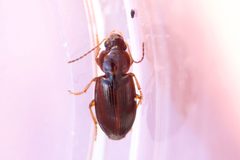
Agonoleptus conjunctus is a small ground beetle in the tribe Stenolophini, commonly known as the Adjoining Harp Ground Beetle. The was described by Thomas Say in 1823 and occurs across a broad range from southern Canada through the United States to Central America. As a member of the Carabidae , it is a predatory active on the ground surface.
Pronunciation
How to pronounce Agonoleptus conjunctus: /ˌæɡəˈnoʊlɛptəs kənˈdʒʌŋktəs/
These audio files are automatically generated. While they are not always 100% accurate, they are a good starting point.
Identification
Distinguished from other Agonoleptus and related Stenolophini by subtle morphological features of the male genitalia and elytral microsculpture. Accurate identification requires reference to taxonomic keys for North American harpaline beetles and comparison with type material. The species occurs in sympatry with other small carabids in the Stenolophus and Acupalpus, from which it differs in pronotal shape and elytral patterns.
Images
Appearance
Small ground beetle with typical Stenolophini : compact body, relatively short , and thread-like . The name 'conjunctus' (Latin for 'joined' or 'connected') may refer to markings or structural features on the elytra or pronotum, though specific diagnostic characters require examination of .
Habitat
Ground-dwelling in open, disturbed, or early successional typical of many Stenolophini. Specific microhabitat preferences are not well documented but likely include bare or sparsely vegetated ground, agricultural fields, and riparian margins.
Distribution
Transcontinental in North America: recorded from Canada (southern Ontario and prairie provinces), throughout the contiguous United States, and south through Mexico to Guatemala. The broad latitudinal range suggests for varied climatic conditions.
Seasonality
likely active during warmer months; specific undocumented. Most ground beetles in this tribe show spring-fall activity peaks with summer dormancy in hotter regions.
Behavior
or ground hunter, typical of Carabidae. Rapid running when disturbed. capability presumed based on wing of tribe Stenolophini, though direct observations lacking.
Ecological Role
of small and scavenger; contributes to of agricultural pests and nutrient cycling in soil . Member of the ground in early successional .
Human Relevance
No documented economic importance. Incidental presence in agricultural systems may provide minor pest control benefits. Not a household pest or of conservation concern.
Similar Taxa
- Stenolophus spp.Similar small size, preference, and general appearance; distinguished by more elongate body form and different pronotal shape
- Acupalpus spp.Overlapping distribution and size; separated by elytral patterns and male genitalic structure
- Agonoleptus rotundatus with potentially overlapping range; requires examination of aedeagal for definitive separation
More Details
Taxonomic History
Originally described by Thomas Say in 1823, placing it among the earliest described North American carabid . The Agonoleptus was established to accommodate species formerly placed in Stenolophus with distinctive aedeagal and elytral characters.
Conservation Status
Not assessed by IUCN. Wide distribution and occurrence in disturbed suggest stable status, though localized impacts from agricultural intensification possible.