
Tetragonoderus laevigatus
Chaudoir, 1876
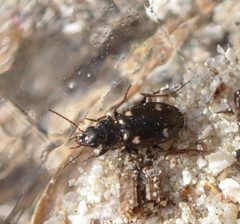
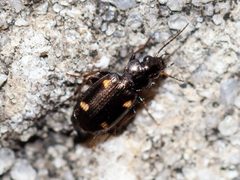
Tetragonoderus laevigatus is a small ground beetle in the Carabidae, first described by Chaudoir in 1876. The is native to South America but has been introduced to the southeastern United States, where it has been recorded in Florida, Georgia, Mississippi, and Louisiana. It belongs to the tribe Lebiini, a diverse group of carabid beetles often associated with vegetation and ground-dwelling .
Pronunciation
How to pronounce Tetragonoderus laevigatus: /tɛtraɡəˈnɒdərəs lɛvɪˈɡeɪtəs/
These audio files are automatically generated. While they are not always 100% accurate, they are a good starting point.
Images
Distribution
Native to South America with confirmed records from Argentina, Brazil, and Uruguay. Introduced to North America; established in the southeastern United States with documented occurrences in Florida, Georgia, Mississippi, and Louisiana.
Human Relevance
An introduced in the southeastern United States, though its ecological impact in the invaded range has not been documented.
More Details
Taxonomic Note
The Tetragonoderus is placed in the tribe Lebiini within the Harpalinae. Members of this genus are generally small, often metallic beetles with compact body forms.
Introduction History
The timing and mechanism of introduction to the southeastern United States is not documented in available sources. The appears to be established based on multiple state records.