
Gehringiinae
Genus Guides
1Gehringiinae is a small of ground beetles (Carabidae) containing approximately 20 described across two : Gehringia and Zuphioides. Members are minute to small beetles, generally less than 3 mm in length, adapted to specialized microhabitats. The subfamily was established to accommodate with distinctive morphological features that separate them from other carabid lineages. They are among the smallest carabid beetles and are rarely encountered due to their cryptic habits.
Pronunciation
How to pronounce Gehringiinae: /ɡeɪˈrɪn.dʒi.aɪ.niː/
These audio files are automatically generated. While they are not always 100% accurate, they are a good starting point.
Identification
Distinguished from other Carabidae by the combination of minute size (<3 mm), strongly constricted waist creating a petiole-like appearance, short exposing abdominal apex, and reduced . Resembles small rove beetles (Staphylinidae) but has fully developed elytra covering most of (though abbreviated) and lacks the exposed abdominal segments typical of staphylinids. -like appearance separates them from most other small carabids. Gehringia has 11-segmented ; Zuphioides has 10-segmented antennae. Examination of genitalia often required for definitive identification.
Images
Appearance
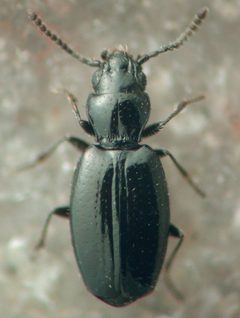
Extremely small beetles, usually 1.5–2.5 mm in length. Body form is compact and somewhat -like, with a strongly constricted waist between pronotum and . Elytra are short, often exposing one or more abdominal tergites. are and relatively short. are reduced and not prominently visible. Legs are slender and relatively long for body size. Coloration is generally dark brown to black, sometimes with paler appendages. The overall gestalt resembles small ants or tiny staphylinid beetles.
Habitat
Specialized microhabitats including gravel banks of rivers and streams, lake shores, and moist sandy or pebble-strewn ground. Often found in spaces among small stones and in gravel deposits where water levels fluctuate. Some associated with moss and debris in riparian zones. Require humid conditions and are sensitive to desiccation.
Distribution
Holarctic distribution. Gehringia occur in North America (western United States and Canada) and eastern Asia (Japan, Russian Far East). Zuphioides is primarily Palearctic, with species in Europe and Asia. The shows a classic trans-Beringian distribution pattern.
Seasonality
active during warmer months; peak activity in spring and early summer in temperate regions. Activity influenced by moisture availability and water levels in riparian .
Behavior
Cryptic, ground-dwelling beetles that remain concealed in spaces of gravel and pebble substrates. Move rapidly when exposed. Capable of surviving periodic inundation. Likely of minute arthropods and other small in their microhabitat, though direct observations of feeding are scarce.
Ecological Role
Presumed micro- in gravel bank and riparian ; contribute to regulation of of tiny in specialized . Serve as indicators of stable, undisturbed gravel bank with natural hydrological regimes.
Human Relevance
No direct economic importance. Occasionally collected by carabidologists. Potential use as bioindicators for riparian quality and natural flow regimes in river systems.
Similar Taxa
- BembidiinaeContains many small riparian carabids, but lacks the strongly constricted waist and -like body form; always complete, covering entire .
- StaphylinidaeRove beetles share short and somewhat similar appearance, but have only 3–6 visible abdominal segments exposed and lack the carabid-type mandibular structure; insertion and hind wing folding also differ.
- PaussinaeSome paussines have constricted waists and -like forms, but are generally larger, often myrmecophilous, and have very different antennal and leg modifications.
More Details
Taxonomic history
Gehringiinae was established by Darlington in 1933 based on the unusual Gehringia, named in honor of Mr. Gehring who collected the first specimens. The has been variously treated as a tribe within other subfamilies or as a separate subfamily; current molecular and morphological evidence supports its status as a distinct subfamily within Carabidae.
Conservation status
Most are poorly known with insufficient data for IUCN assessment. degradation from river regulation, gravel extraction, and riparian development poses threats to specialized gravel bank species.