
Parvindela terricola imperfecta
Imperfect Tiger Beetle
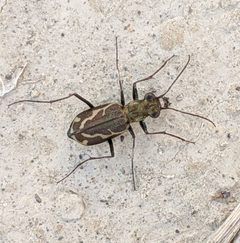
Parvindela terricola imperfecta is a of tiger formerly classified under Cicindela and later Cylindera, now placed in the Parvindela following elevation of the former subgenus Cylindera to generic rank. It is distinguished by bright metallic green coloration, dense setae on the and legs, and reduced or absent elytral maculations. The subspecies name 'imperfecta' refers to the incomplete or reduced white markings on the compared to other subspecies. It occurs in the Great Plains region of North America, including Nebraska.
Pronunciation
How to pronounce Parvindela terricola imperfecta: /pɑrˈvɪndɛlə tɛˈrɪkələ ɪmˌpɜrfɛkˈtɑ/
These audio files are automatically generated. While they are not always 100% accurate, they are a good starting point.
Identification
Distinguished from Cicindela sexguttata by dense setae on the front of the (glabrous in sexguttata). Separated from Cicindela scutellaris by more slender body, longer legs, and uniform green without red or purple tints. Differs from Cicindela decemnotata by brighter, less oily green coloration and more extensive setae. Distinguished from other Parvindela terricola by reduced or absent elytral maculations; subspecies kaibabensis has connected maculations and occurs in Arizona, not the Great Plains.
Images
Appearance
Bright metallic green overall coloration, often vivid and sometimes with bluish tints. and legs densely covered with setae (hairs), particularly prominent on the front of the head and . creamy white to pale yellow with three dark teeth. with creamy white basal third. with reduced, incomplete, or absent white maculations—typically showing only partial humeral lunules rather than full patterns. Body more slender and longer-legged than Cicindela scutellaris. large and prominent. .
Habitat
Open, sandy or bare soil in grassland and prairie environments. Occupies areas with sparse vegetation cover suitable for hunting.
Distribution
Great Plains region of North America; recorded from Nebraska and surrounding states. Not known from the southwestern United States (unlike kaibabensis).
Diet
Active predatory hunter; captures small arthropods. Specific prey items not documented.
Behavior
Fast-running, typical of tiger beetles. Has been observed to be an active hunter on open ground.
Ecological Role
in open grassland and prairie ; contributes to .
Human Relevance
Subject of entomological interest and identification challenges; former name Cicindela denverensis used in older literature.
Similar Taxa
- Cicindela sexguttataSimilar bright green coloration, but distinguished by glabrous (hairless) front of and usually more bluish tint; occurs in eastern woodlands
- Cicindela scutellarisSome share green coloration, but stockier body, shorter legs, red or purple elytral tints, and different geographic range
- Cicindela decemnotataSimilar size and shape, but less bright green coloration, often with oily sheen and some red tinting; rare in Nebraska
- Parvindela terricola kaibabensisFormerly considered same , but has connected elytral maculations and occurs in Arizona grasslands north of Grand Canyon
Misconceptions
Formerly classified as Cicindela denverensis, a name still encountered in older sources. The subgenus Cylindera was elevated to rank, then subsequently split, with this placed in Parvindela rather than Cylindera.
More Details
Taxonomic History
This has undergone multiple reclassifications. Originally described as Cicindela denverensis, it was later treated as Cicindela terricola imperfecta. The subgenus Cylindera was elevated to full rank, making it Cylindera terricola imperfecta. More recently, the genus Cylindera was split, and this was transferred to the new genus Parvindela.
Etymology
The epithet 'imperfecta' refers to the reduced or incomplete white maculations on the compared to other subspecies of P. terricola.