
Carabus auratus
Linnaeus, 1760
Golden Ground Beetle
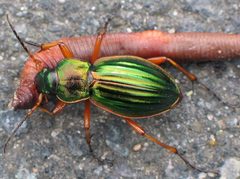
Carabus auratus, commonly known as the golden ground beetle, is a flightless predatory in the Carabidae. Native to central and western Europe, it has been introduced to North America. are hunters that prey on insects, snails, and worms using digestive secretions to subdue prey. The is considered beneficial in agricultural settings due to its on pest species such as the Colorado potato beetle.

Pronunciation
How to pronounce Carabus auratus: /kəˈræbəs ɔːˈreɪtəs/
These audio files are automatically generated. While they are not always 100% accurate, they are a good starting point.
Identification
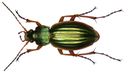
Distinguished from similar ground beetles by the combination of iridescent gold-green coloration on , , and , paired with orange appendages. The three broad longitudinal grooves on each elytron are diagnostic. Flightless condition and activity pattern further separate it from many Carabus . Size range of 17–20 mm helps distinguish it from smaller .
Images
Appearance
measure 17–20 mm in body length. The display an iridescent gold-green coloration, each marked with three broad longitudinal grooves. The and share this gold-green iridescence. Legs, , and mouthparts are orange. The is flightless.
Habitat
Occurs in fields and shrubby areas, particularly on loamy soils. Occasionally climbs into trees. Requires shelter such as stones or moss for .
Distribution
Native to central and western Europe including Great Britain, Denmark, Sweden, France, Belgium, Netherlands, Germany, Switzerland, Austria, Czechia, Poland, and Spain. Introduced to North America (USA).
Seasonality
active during daytime throughout the growing season. Larvae hunt at dawn. Adults emerge from in autumn and overwinter. Life expectancy approximately two years.
Diet
Predatory. feed on insects, snails, and worms, seizing prey with and spraying with digestive secretion prior to consumption. Documented to prey on agricultural pests including the Colorado potato beetle (Leptinotarsa decemlineata).
Host Associations
- Leptinotarsa decemlineata - preyColorado potato beetle, agricultural pest
Life Cycle
Complete . Larvae hunt exclusively at dawn, undergo three , then pupate in soil. emerge in autumn. occurs under stones or moss. Life span approximately two years.
Behavior
. actively hunt during daylight hours. Larvae exhibit hunting restricted to dawn. Adults occasionally climb vegetation. Overwinters in sheltered microhabitats.
Ecological Role
in terrestrial . Functions as agent in agricultural and garden through on herbivorous pests.
Human Relevance
Considered beneficial to farmers and gardeners due to on crop pests, particularly the Colorado potato beetle. No documented negative impacts.
Similar Taxa
- Carabus nemoralisSimilar size and preference; distinguished by coloration (C. nemoralis typically bronze or coppery without gold-green iridescence) and elytral
- Other Carabus speciesMany share ground beetle ; C. auratus distinguished by unique gold-green iridescence combined with orange appendages and three longitudinal elytral grooves
More Details
Subspecies
Four recognized: C. auratus auratus (widespread including introduced USA ), C. auratus honnoratii (France), C. auratus lasserrei (France), C. auratus lotharingus (France)
Sources and further reading
- BugGuide
- Wikipedia
- GBIF taxonomy match
- iNaturalist taxon
- NCBI Taxonomy
- Catalogue of Life
- Bug Eric: Wasp Wednesday: Pseudomalus auratus
- Thinking small: how bugs are getting bulldozed by planning - Buglife Blog - Buglife
- Bane of dogbane, the beautiful and the ugly: Dogbane leaf beetle, Chrysochus auaratus, and dogbane webworm, Saucrobotys futilalis — Bug of the Week
- Monitoring Ecological Change with Northern Beetles
- What do insects do in winter, Part 2? Tolerating the big chill: Banded woolly bears, Pyrrharctia isabella, field crickets, Gryllus spp., baldfaced hornets, Dolichovespula maculata, and others — Bug of the Week
- Agrilus fuscipennis on Persimmon | Beetles In The Bush