
Arenivaga
Rehn, 1903
sand cockroaches, desert cockroaches
Species Guides
11- Arenivaga apacha(Apache sand cockroach)
- Arenivaga bolliana(Boll's sand cockroach)
- Arenivaga erratica(erratic sand cockroach)
- Arenivaga floridensis(Florida Sand Cockroach)
- Arenivaga gaiophanes(desert cockroach)
- Arenivaga genitalis(Arizona sand cockroach)
- Arenivaga hopkinsorum(desert cockroach)
- Arenivaga investigata(desert cockroach)
- Arenivaga sequoia(desert cockroach)
Arenivaga is a of sand cockroaches in the Corydiidae, comprising approximately 48 distributed across the southwestern United States, Florida, and Mexico. These insects are highly adapted to arid environments, inhabiting sandy soils and dunes with moisture content below 1%. The genus exhibits extreme , with winged males and wingless, females that 'swim' through sand. A 2014 revision by Heidi Hopkins added 39 new species to the previously known nine, revealing a remarkable radiation in desert .
Pronunciation
How to pronounce Arenivaga: //ˌærɪˈnaɪvəɡə//
These audio files are automatically generated. While they are not always 100% accurate, they are a good starting point.
Identification
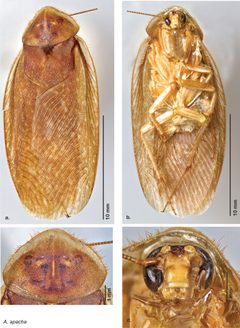
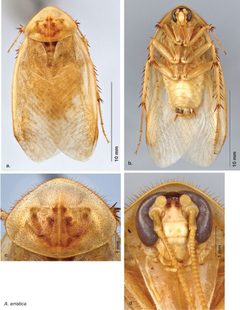
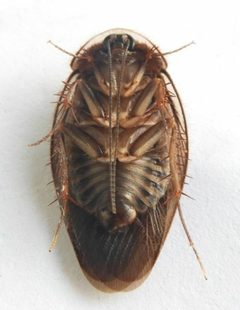
identification relies primarily on examination of male genitalia, which display complex and species-specific morphological characters. Males possess fully developed wings that typically extend beyond the , while females are and dorso-ventrally flattened with adaptations. Body size ranges from 14 mm (A. pumila) to 24 mm (A. bolliana). Coloration varies with diet due to pigment from food sources and variable accumulation, rendering it unreliable for species distinction. The pronotum is large, covering the and extending laterally to body width, with species-specific patterning that may be impressed into the surface and surrounded by radiating aurae. White or pale pink uric acid patches may occur laterally on the pronotum. Legs bear numerous spines, including spines at the meso-meta-tibial joint; typically have two claws (reduced to one in A. darwini). The and are into an unusual bulge not seen in other .
Images
Habitat
Sandy soils and dunes in arid and semi-arid regions, particularly in the southwestern United States, Florida sand ridges, and Mexico. Inhabits environments with less than 1% soil moisture for most of the year. Occurs primarily in sand dunes at the base of desert mountains and in Florida scrub . Strongly associated with the presence of desert shrubs, where individuals are found more commonly in sand near or under shrubs than in open sand. Co-occurs in burrows of small mammals.
Distribution
Southwestern United States (California, Arizona, New Mexico, Texas), Florida sand ridges, and Mexico. GBIF records indicate presence in northwestern, north-central, northeastern, and southeastern U.S.A. as well as Mexico. The shows a disjunct distribution with core in the Chihuahuan and Sonoran Desert regions and isolated populations on Florida sand ridges.
Diet
Decaying leaves and roots of desert shrubs; shrub roots (35–38% moisture content) serve as the primary water source. Females and nymphs feed on mycorrhizal fungi, plant detritus, and seeds gathered by cohabiting small mammals.
Behavior
Exhibits pronounced in and microhabitat use. Females and nymphs are and photonegative, 'swimming' through sandy substrate and residing underground in mammal burrows. Males are surface-dwelling with brief lives. vertical occurs seasonally: during spring, summer, and fall, individuals burrow 20–60 cm deep during daytime heat, then migrate to 1–3 cm depth at night when surface temperatures cool; in winter, individuals remain at lower depths continuously. Adult males are never found at 1–3 cm depth, occurring only on the surface or at 20–60 cm. Summer surface migration is delayed approximately 2 hours compared to spring and fall, correlated with delayed nighttime cooling. Females emerge onto the surface at night, possibly using to attract winged males for mating, then rebury themselves. Arenivaga investigata can absorb water vapor from unsaturated atmospheres above 82.5% relative humidity through specialized bladder-like hypopharyngeal extensions, a critical physiological for desert survival.
Ecological Role
Decomposers in arid , contributing to nutrient cycling in environments with minimal plant matter. Specialized consumers of mycorrhizal fungi and plant detritus in sandy substrates. Serve as prey for various desert .
Similar Taxa
- Supella longipalpaBoth exhibit in wing development, but Supella is a domestic pest with reduced wings in females rather than complete aptery, and lacks the adaptations and desert specialization of Arenivaga.
- Other CorydiidaeArenivaga is distinguished by its extreme , hypopharyngeal water vapor absorption structures, and specialized sand-dwelling ; most other Corydiidae lack these combined features.
Sources and further reading
- BugGuide
- Wikipedia
- GBIF taxonomy match
- iNaturalist taxon
- NCBI Taxonomy
- Catalogue of Life
- Primary Type List | Entomology Research Museum
- Arenivaga-wp - Entomology Today
- Thirty-nine new species of endemic cockroach discovered in the southwestern US and Mexico | Blog
- Pensoft Editorial Team | Blog - Part 130
- Pensoft blog - Part 131
- Bug Eric: The Saga Concludes
- Nest Distribution and Flight Biology of Paratrechina arenivaga (Hymenoptera: Formicidae)
- Site of water vapor absorption in the desert cockroach, Arenivaga investigata.
- Ecology and behavior of the desert burrowing cockroach,Arenivaga sp. (Dictyoptera, Polyphagidae)
- Distribution and Status of the Cockroach Arenivaga floridensis Caudell, a Florida Sand Ridge Endemic
- Distribution and Activity of the Desert Cockroach Arenivaga Investigata (Polyphagidae) in Relation to Microclimate