
Corydiinae
Saussure, 1864
sand cockroaches
Genus Guides
2- Arenivaga(sand cockroaches)
- Eremoblatta(sand cockroaches)
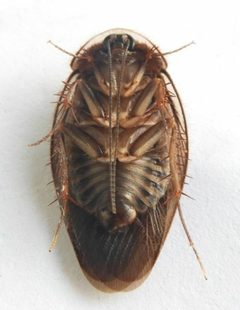
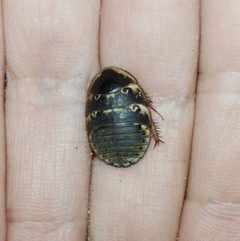
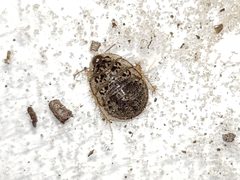
Corydiinae is a of within the Corydiidae, comprising approximately 20 and commonly known as sand cockroaches. The subfamily contains half the genera in Corydiidae and includes notable such as the desert cockroach, Arenivaga investigata. Recent taxonomic revisions have reorganized the classification into three major genus groups based on morphological characters, with significant changes to generic boundaries and the exclusion of several formerly included genera.
Pronunciation
How to pronounce Corydiinae: //kɔːˈrɪ.di.aɪˌniː//
These audio files are automatically generated. While they are not always 100% accurate, they are a good starting point.
Identification
Corydiinae can be distinguished by leg spine armament, particularly the presence or absence of an spine on the of the front leg. The is divided into three groups: the Therea-group (genera Homoeogamia, Ergaula, Eucorydia, Therea) characterized as likely the most basal; the Arenivaga-group (Arenivaga, Eremoblatta, Polyphagina); and the Polyphaga-group (Anisogamia, Eupolyphaga, Polyphaga, and Palaearctic genera lacking frontleg femoral spines). Pronounced occurs in some genera: males are often with tegmina, while females may be and more robust. Male genitalia (phallomeres) and female spermatheca structure provide important diagnostic characters at the level.
Images
Habitat
Many inhabit sandy or desert environments, reflected in the "sand cockroaches." The desert cockroach Arenivaga investigata occupies arid regions. Some occur in mountainous areas; for example, Pseudoeupolyphaga species are found in the complex mountain systems of southwestern China (Yunnan, Sichuan, Tibet), where geographic isolation has facilitated speciation.
Distribution
The has a disjunct distribution across the Nearctic and Palaearctic regions. The Therea-group is Nearctic (with some Old World : Ergaula, Eucorydia, Therea). The Arenivaga-group spans Nearctic (Arenivaga, Eremoblatta) and Palaearctic (Polyphagina) regions. The Polyphaga-group includes Palaearctic genera (Heterogamodes, Hemelytroblatta, Nymphrytria, Psammoblatta, Fissidentoblatta) and additional genera (Anisogamia, Eupolyphaga, Polyphaga). The genus Pseudoeupolyphaga is to China, with highest diversity in Yunnan Province. The Maltese fauna includes Heterogamisca jeffreyana.
Life Cycle
() have been described and illustrated for several in Eupolyphaga and Pseudoeupolyphaga, with serrations observed on some oothecae. Nymphs have been collected for some Pseudoeupolyphaga species. Laboratory maintenance of specimens has been reported.
Similar Taxa
- AustropolyphagaFormerly placed in Corydiinae but removed based on shape and size of the postclypeal shield; excluded from the .
- PolyphagoidesFormerly placed in Corydiinae but removed based on shape and size of the postclypeal shield; excluded from the .
- HypercompsaErroneously added to Corydiinae by Roth; excluded from the .
- CryptocercusExcluded from Corydiinae despite unification of and Homoeogamiidae; belongs elsewhere in Blattodea.
Sources and further reading
- BugGuide
- Wikipedia
- iNaturalist taxon
- NCBI Taxonomy
- Catalogue of Life
- A taxonomic study of Eupolyphaga Chopard, 1929 (Blattodea: Corydiidae: Corydiinae)
- Four new species of the genus Pseudoeupolyphaga Qiu & Che, 2024 (Blattodea, Corydioidea, Corydiinae) from Yunnan, China
- The spine armament of the legs as an important means for the characterisation of the genera of Corydiinae and their relationships (Blattodea, Corydiidae)
- New species of Eupolyphaga Chopard, 1929 and Pseudoeupolyphaga Qiu & Che, 2024 (Blattodea, Corydioidea, Corydiinae), with notes on their female genitalia.