
Nasutitermitinae
Hare, 1937
Nasute Termites
Genus Guides
1Nasutitermitinae is a of higher termites within Termitidae, comprising 81 and approximately 605 with near- distribution. The subfamily is distinguished by a highly derived soldier bearing and a prominent fontanellar process (the nasus) used to project chemical defenses. Notable genera include Nasutitermes, Hospitalitermes, and Constrictotermes, the latter two recognized for forming conspicuous above-ground foraging trails.
Pronunciation
How to pronounce Nasutitermitinae: //ˌnasjuˌtɪˌmɜːmɪˈtaɪniː//
These audio files are automatically generated. While they are not always 100% accurate, they are a good starting point.
Identification
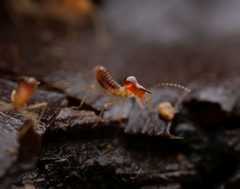
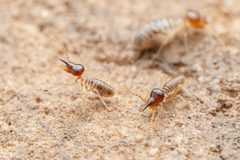
Soldiers are immediately recognizable by the nasus—a horn-like or elongated frontal projection absent in other . The combination of and this fontanellar gun distinguishes Nasutitermitinae from all other termite groups. lack the nasus and require examination of gut structure or molecular analysis for definitive identification to subfamily.
Images
Appearance
Soldiers possess a distinctive elongated frontal projection (nasus) on the , from which chemical weaponry is expelled. are reduced or in the soldier . have conventional with functional mandibles. Nests vary from inconspicuous internal cavities to conspicuous arboreal or epigeal structures depending on .
Habitat
Occurs across diverse tropical and subtropical including tropical rainforest, woodland, and disturbed areas. Specific habitat associations vary by : Hospitalitermes and Constrictotermes are notable for forming extensive arboreal or surface foraging columns in open forest, while other genera occupy more cryptic nesting sites within wood or soil.
Distribution
Near- in tropical and subtropical regions. Documented from Papua New Guinea (22 ), Australia, Neotropics (including first non- U.S. establishment in Florida), West Africa, and Amazonia. New records continue to extend known ranges, with some species distributions expanding over 1,000 km with additional sampling.
Diet
Wood-feeding; many consume dead wood on living trees and structural wood. Specific dietary breadth varies by species—some feed on diverse wood species, others may have more restricted substrates. No evidence of soil-feeding or fungus- in this .
Life Cycle
Hemimetabolous development with differentiation producing reproductives, soldiers, and . caste (winged reproductives) described for multiple including Caetetermes and Coendutermes. Colony foundation and detailed developmental stages not documented in available sources.
Behavior
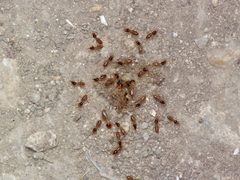
Soldiers employ chemical defense via the fontanellar gun, projecting substances from the nasus to deter such as ants. Hospitalitermes and Constrictotermes exhibit distinctive open-air foraging , forming visible trails across forest surfaces and vegetation. Some construct conspicuous nests observable from ground level.
Ecological Role
Decomposers of wood and plant material in tropical and subtropical . Contribute to nutrient cycling through breakdown of lignocellulosic material. Some may significantly impact wooden structures, with Nasutitermes corniger recognized as economically important.
Human Relevance
Nasutitermes corniger (conehead ) represents the first non- establishment of Termitidae in the United States (Florida), where it damages structural wood and dead wood on living trees. Some are significant economic pests of timber and wooden structures. Research interest in chemical defense mechanisms and evolution.
Similar Taxa
- Other Termitidae subfamiliesLack the nasus and fontanellar gun; soldiers retain functional for defense
- RhinotermitidaeLower with different gut complement and soldier lacking nasus
More Details
Taxonomic scope
The contains 81 and 605 per current catalogues. Recent taxonomic revisions have established new genera including Niuginitermes and Diwaitermes from Papua New Guinea, and clarified synonymies within Diversitermes.
Defense mechanism
The fontanellar gun represents a unique evolutionary innovation among , converting what is a glandular opening in other groups into a projecting nozzle capable of directing chemical defenses at distance rather than requiring contact.
Sources and further reading
- BugGuide
- Wikipedia
- iNaturalist taxon
- NCBI Taxonomy
- Catalogue of Life
- Collecting in Australia’s remote McIlwraith range | Beetles In The Bush
- Tropical fungus gardeners: Leafcutter ants, Atta spp. — Bug of the Week
- THE AUSTRALIAN TERMITE GENUS OCCULTITERMES EMERSON (ISOPTERA: TERMITIDAE: NASUTITERMITINAE)
- The nasute termites (Isoptera : Nasutitermitinae) of Papua New Guinea
- Conehead Termite Nasutitermes corniger (Motschulsky) (Insecta: Blattodea: Termitidae: Nasutitermitinae)
- Observation on Cyranotermes Araújo, with a description of C. Caete, new species. (Isoptera, Termitidae, Nasutitermitinae)
- Coendutermes tucum Fontes (Isoptera, Termitidae, Nasutitermitinae): description of the imago caste and additional notes
- A taxonomic revision of the neotropical termite genus Diversitermes (Isoptera: Termitidae: Nasutitermitinae)
- Caetetermes taquarussu Fontes (Isoptera, Termitidae, Nasutitermitinae): description of the imago caste and new distributional records
- Dismantling of a New Structure Associated With Foraging in the West African Termite Trinervitermes geminatus (Wasmann) (Isoptera: Termitidae: Nasutitermitinae)
- New records for Coatitermes pallidus (Snyder, 1926) and Coatitermes clevelandi (Snyder, 1926) (Isoptera, Termitidae, Nasutitermitinae) from Amazonia
- Nasutitermes aurantius (Isoptera, Termitidae, Nasutitermitinae), a new nasutiform termite species from Panama and a key to soldiers of Central American Nasutitermes Dudley, 1890.