
Cryptocercidae
Handlirsch, 1925
brown-hooded cockroaches, wood roaches
Genus Guides
1- Cryptocercus(wood roach)
Cryptocercidae is a of wingless, subsocial comprising the single Cryptocercus. These insects are obligate inhabitants of decaying wood in temperate montane forests across eastern Asia and North America. They exhibit extended parental care and share wood-digesting gut with , supporting the hypothesis of termite evolution from within cockroaches. The family is notable for its limited ability and sensitivity to forest patterns.
Pronunciation
How to pronounce Cryptocercidae: //ˌkrɪptoʊˈsɜːrsɪˌdiː//
These audio files are automatically generated. While they are not always 100% accurate, they are a good starting point.
Identification
Distinguished from other by complete winglessness in , obligate association with rotting wood, and subsocial with extended parental care. Unlike , retain cockroach characteristics including asymmetrical male genitalia and oothecal . Distinguished from other wingless cockroaches by geographic restriction to temperate montane forests and specific wood-feeding .
Images
Appearance
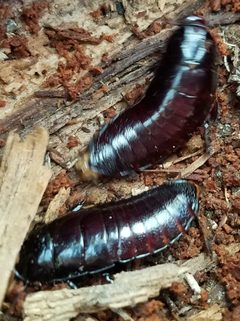
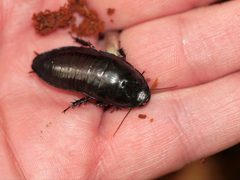
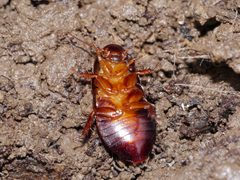
Wingless with reduced or absent wings in both sexes. possess a distinct brownish coloration with a darker, hood-like pronotum. Body form is dorsoventrally flattened and adapted for moving within wood galleries. capsule width shows little intraspecific variation and no significant in this trait. Females are heavier than males in dry weight.
Habitat
Decaying wood in old-growth temperate montane forests. Inhabits rotting logs and stumps, creating galleries within the wood substrate. In eastern North America, occurs in monadnock formations and Appalachian montane . In Asia, associated with forests of the Hengduan Mountains, Qin-Daba Mountains, and similar montane regions. Dependent on forest dynamics and stable wood decay conditions.
Distribution
Disjunct distribution across eastern Asia (China, Korea, Russian Far East) and North America. In North America: Southern Appalachian Mountains from southwestern New York to Alabama, with isolated on monadnocks in the Piedmont of North Carolina, and northwestern United States. In Asia: western Sichuan Plateau, Hengduan Mountains, Qin-Daba Mountains, and montane forests of China, Korea, and the Russian Far East.
Diet
Wood; feeds exclusively on decaying wood. Digests cellulose through symbiotic gut bacteria and flagellate protozoans transferred from parents to offspring.
Life Cycle
Extended life within wood galleries. involves monogamous pair formation with biparental cooperation. Females produce one to four containing 13-22 nymphs. Nymphs require considerable parental interaction and remain with parents for an extended period. Parents transfer symbiotic gut protozoans to offspring through anal . Females may recover nitrogen by consuming oothecae after hatch.
Behavior
Subsocial with extended parental care including biparental cooperation. Monogamous pairs form and feed together in the same log for nearly a year prior to . Limited capability due to dependence on stable forest and wood substrate. Parent-offspring interaction required for transfer and nymphal development.
Ecological Role
Decomposer in forest ; contributes to wood decay and nutrient cycling in temperate montane forests. Serves as for symbiotic bacteria and protozoans that enable cellulose digestion.
Human Relevance
Important for understanding evolution due to shared wood-digesting gut and subsocial . Considered evidence that termites evolved from social . Subject of conservation concern due to dependence on old-growth montane forests and sensitivity to fragmentation.
Similar Taxa
- BlattidaeOther ; distinguished by wing presence in most , lack of subsocial with extended parental care, and habits rather than obligate wood-feeding
- Termitidae and other termite familiesConvergent wood-feeding and social ; distinguished by eusocial system, symmetrical male genitalia, and different developmental . Cryptocercidae retains characteristics and lacks true castes
- Panesthiinae (wood-feeding cockroaches)Other wood-feeding ; distinguished by distribution in tropical and subtropical regions, different , and lack of the specific subsocial system found in Cryptocercidae
More Details
Evolutionary significance
Cryptocercidae is central to hypotheses about origins. The shared gut (oxymonadid and hypermastigid flagellates) with lower termites, combined with subsocial and wood-feeding , support the hypothesis that termites evolved from within the lineage, specifically from a Cryptocercus-like ancestor.
Biogeographic history
Molecular dating indicates divergence of American and Asian lineages at approximately 74.8 Ma, with Asian diversification beginning around 30.7 Ma. The uplift of the Qinghai-Tibet Plateau and Quaternary climatic oscillations have influenced the disjunct distribution patterns observed in Asian lineages.
Conservation status
are sensitive to fragmentation and forest disturbance due to limited ability and dependence on old-growth forest . in montane habitats may serve as indicators of forest integrity.
Sources and further reading
- BugGuide
- GBIF taxonomy match
- iNaturalist taxon
- NCBI Taxonomy
- Catalogue of Life
- Phylogenetic Status, Distribution, and Biogeography of Cryptocercus (Dictyoptera: Cryptocercidae)
- Cryptocercus punctulatus (Dictyoptera: Cryptocercidae) from Monadnocks in the Piedmont of North Carolina
- Initial reproductive investment and parental body size in Cryptocercus punctulatus (Dictyoptera: Cryptocercidae)
- Reproduction in the Woodroach Cryptocercus punctulatus Scudder (Dictyoptera: Cryptocercidae): Mating, Oviposition, and Hatch
- Distribution of Karyotypes of the Cryptocercus punctulatus Species Complex (Blattodea: Cryptocercidae) in Great Smoky Mountains National Park
- Evolution in the genus Cryptocercus (Dictyoptera: Cryptocercidae): no evidence of differential adaptation to hosts or elevation
- Colony composition, protozoan transfer and some life history characteristics of the woodroach Cryptocercus punctulatus Scudder (Dictyoptera: Cryptocercidae)
- Geographic Distribution of, and Genetic Variation in, the Wood Roach <I>Cryptocercus</I> (Dictyoptera: Cryptocercidae) in the United States
- Description of Cryptocercus clevelandi (Dictyoptera: Cryptocercidae) from the Northwestern United States, Molecular Analysis of Bacterial Symbionts in its Fat Body, and Notes on Biology, Distribution, and Biogeography
- Chromosome number diversity in Asian Cryptocercus (Blattodea, Cryptocercidae) and implications for karyotype evolution and geographic distribution on the Western Sichuan Plateau
- Distribution of Karyotypes of the <I>Cryptocercus punctulatus</I> Species Complex (Dictyoptera: Cryptocercidae) in the Southern Appalachians: Relation to Habitat and History
- Uplift‐driven diversification revealed by the historical biogeography of the cockroach Cryptocercus Scudder (Blattodea: Cryptocercidae) in eastern Asia