
Willowsia buski
(Lubbock, 1870)
damp grain springtail
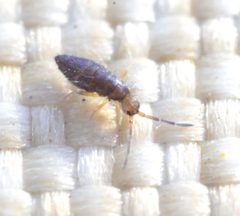
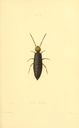
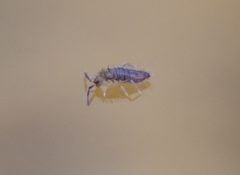
Willowsia buski is a medium-sized , averaging 1-2 mm in length, with a smooth, dark-purple to black body and a lighter-colored . It is found in abundance throughout North America and Europe, with likely distribution. The is known to infest stored dry goods, particularly grain, when moisture levels are elevated. It belongs to the Entomobryidae, characterized by four roughly equal antennal segments.
Pronunciation
How to pronounce Willowsia buski: //wɪˈloʊ.si.ə ˈbʌs.ki//
These audio files are automatically generated. While they are not always 100% accurate, they are a good starting point.
Identification
The lighter-colored distinguishes Willowsia buski from similar dark-bodied springtails. It has four roughly equal antennal segments, consistent with all Entomobryidae. Fine setae are present over the body surface. The smooth, dark-purple to black coloration with contrasting head coloration is a key visual cue.
Images
Habitat
Associated with stored dry goods, particularly grain, when moisture levels are elevated; specific natural requirements are not well documented in available sources.
Distribution
North America and Europe in abundance; likely distribution based on occurrence records. GBIF distribution records also indicate presence in Andean, Antarctic & Subantarctic, Arctic & Sub-arctic, and Continental S.E. Asia regions.
Behavior
Has been observed infesting stores of dry goods that have become contaminated with high moisture, giving rise to the "damp grain ."
Human Relevance
Considered a pest of stored grain and dry goods when moisture conditions are elevated. The "damp grain " directly reflects this economic association.
Similar Taxa
- Willowsia jacobsoniAnother New World Willowsia ; distinguished by morphological features including chaetotaxy
- Willowsia mexicana New World Willowsia with uninterrupted rib type; differs in color pattern and chaetotaxy
- Willowsia nigromaculataNew World Willowsia ; morphological comparison requires examination of chaetotaxy