
Willowsia nigromaculata
(Lubbock, 1873)
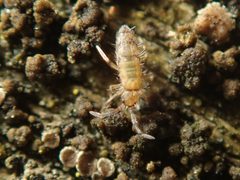
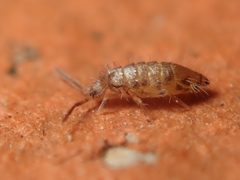
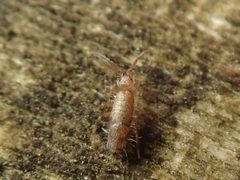
Willowsia nigromaculata is a in the Entomobryidae, characterized by a metallic iridescent body covered in translucent . It is commonly reported as a household pest throughout the northern hemisphere and is among the most abundant and widely distributed springtails. Recent taxonomic revision has revealed that what was previously identified as W. nigromaculata in North America represents a distinct cryptic , Willowsia neonigromaculata, with true W. nigromaculata occurring in Europe.
Pronunciation
How to pronounce Willowsia nigromaculata: /wɪˈloʊ.si.ə ˌni.groʊ.mæk.jəˈleɪ.tə/
These audio files are automatically generated. While they are not always 100% accurate, they are a good starting point.
Identification
True Willowsia nigromaculata can be distinguished from the North American cryptic Willowsia neonigromaculata by the number of inner appendages on the maxillary sublobal plate. It has interrupted rib , unlike some other Willowsia species such as W. mexicana and W. pyrrhopygia which have uninterrupted rib scales. chaetotaxy provides additional diagnostic characters for identification within the .
Images
Appearance
Metallic iridescent body covered in translucent . Morphological studies indicate it has interrupted rib scale type. Diagnostic characters include specific features of the maxillary sublobal plate, which distinguish it from the cryptic Willowsia neonigromaculata.
Habitat
Primarily found in indoor environments including houses, garages, and greenhouses. The has been documented as a common household pest, suggesting to human-modified environments.
Distribution
France (type locality of true W. nigromaculata); widely distributed throughout the northern hemisphere. previously reported from the United States have been reclassified as the distinct Willowsia neonigromaculata. Both species may be present in Canada. GBIF records indicate additional distribution in Arctic and Sub-arctic regions, Caribbean mainland, Continental Southeast Asia, Europe, and India.
Behavior
Commonly reported as a household pest, indicating persistent presence in human dwellings. No specific behavioral details beyond association have been documented.
Human Relevance
Considered a household pest due to its common occurrence in houses, garages, and greenhouses. The ' widespread distribution in indoor environments suggests it may be transported internationally through human activity.
Similar Taxa
- Willowsia neonigromaculataCryptic previously confused with W. nigromaculata; distinguished by number of inner appendages on maxillary sublobal plate; occurs in United States
- Willowsia mexicanaNew World with uninterrupted rib type, unlike W. nigromaculata which has interrupted rib scales
- Willowsia pyrrhopygiaNew World with uninterrupted rib type and distinct color pattern
Misconceptions
Historically, specimens identified as W. nigromaculata from North America were misidentified; these represent a distinct cryptic , Willowsia neonigromaculata. True W. nigromaculata is European in origin.
More Details
Taxonomic Complexity
Recent molecular and morphological analysis (2021) revealed that W. nigromaculata as historically understood comprises at least two distinct . The name W. nigromaculata properly applies to the European , while North American populations represent Willowsia neonigromaculata sp. nov. Further investigations of additional populations are needed to fully resolve the diversity and distribution of this .
Diagnostic Morphology
Key diagnostic characters for separating true W. nigromaculata from related include: number of inner appendages on maxillary sublobal plate, rib type (interrupted vs. uninterrupted), chaetotaxy, and specific features of the outer maxillary lobe and labial triangle setae.
Sources and further reading
- BugGuide
- Wikipedia
- GBIF taxonomy match
- iNaturalist taxon
- NCBI Taxonomy
- Catalogue of Life
- Morphological and molecular analysis of Willowsia nigromaculata (Collembola, Entomobryidae, Entomobryinae) reveals a new cryptic species from the United States
- A new endemic species of Willowsia from Florida (USA) and descriptive notes on all New World Willowsia (Collembola: Entomobryidae)