
Willowsia
Shoebotham, 1917
Species Guides
4- Willowsia buski(damp grain springtail)
- Willowsia neonigromaculata
- Willowsia nigromaculata
- Willowsia platani(slender springtail)
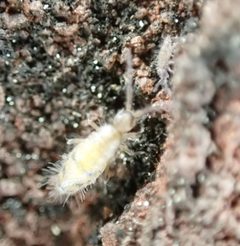
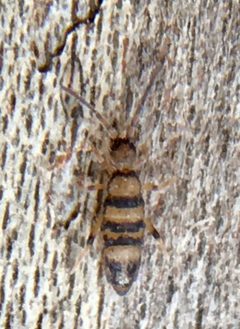
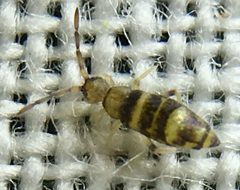
Willowsia is a of slender springtails in the Entomobryidae, containing approximately six described . The genus exhibits a pantropical to distribution, with notable diversity in Asia and multiple species present in the Americas. Some species, particularly W. nigromaculata, are among the most abundant and widely distributed springtails in the northern hemisphere. Phylogenetic studies indicate that Willowsia is polyphyletic, with some species showing closer relationships to other entomobryine . The genus includes both native New World endemics and potentially introduced .
Pronunciation
How to pronounce Willowsia: //wɪˈloʊziə//
These audio files are automatically generated. While they are not always 100% accurate, they are a good starting point.
Identification
Willowsia are distinguished from other Entomobryidae by a combination of morphological characters including patterns and chaetotaxy. New World species (W. mexicana, W. pyrrhopygia) share two unique character states with the Americabrya: the outer maxillary lobe with two sublobal hairs (rather than three) and the absence of labial triangle seta r. Species identification relies on detailed examination of chaetotaxy, color pattern, and the number of inner appendages on the maxillary sublobal plate. The genus includes both scaled and unscaled members, with rib scale type (interrupted versus uninterrupted) serving as a diagnostic feature.
Images
Habitat
Specific preferences for most Willowsia are poorly documented. Willowsia nigromaculata has been reported as a household pest throughout the northern hemisphere, indicating association with human-modified environments. The "damp grain " for W. buski suggests association with moist stored products or granary environments.
Distribution
Pantropical to distribution. High diversity in Asia with several records of W. jacobsoni. Americas: four reported (W. buski, W. jacobsoni, W. mexicana, W. nigromaculata), including two New World species (W. mexicana from Mexico, W. pyrrhopygia from Florida, USA). First record in Brazil and Singapore; W. jacobsoni newly recorded from Brazil. W. nigromaculata complex distributed across northern hemisphere (France, United States, Canada). GBIF distribution records include Andean, Antarctic & Subantarctic, Antillean & S. Florida, Arctic & Sub-arctic, and Caribbean mainland regions.
Life Cycle
Postembryonic development has been described for W. jacobsoni, including developmental stages of chaetotaxy. development was presented for the first time for the , including a new interpretation of primary and secondary . The complete and reproductive remain undocumented for most .
Human Relevance
Willowsia nigromaculata is commonly reported as a household pest throughout the northern hemisphere, making it one of the most frequently encountered domestic springtails. W. buski is known as the "damp grain ," suggesting potential economic significance in stored product contexts. The has been subject to taxonomic revision due to cryptic , which has implications for accurate pest identification and management.
Similar Taxa
- AmericabryaShares two unique character states with New World Willowsia : outer maxillary lobe with two sublobal hairs and absence of labial triangle seta r, suggesting independent evolution from a common New World ancestor.
- Other Entomobryinae generaWillowsia is polyphyletic based on molecular phylogenetic analyses; some show closer relationships to other entomobryine than to each other, complicating generic boundaries.
More Details
Phylogenetic complexity
Molecular based on COI, 16S, and 28S genes have rendered Willowsia polyphyletic, with high support for relationships that place some closer to other entomobryine . This corroborates previous studies and indicates that the current generic classification requires revision.
Cryptic species diversity
Morphological and molecular analysis of W. nigromaculata has revealed at least two distinct : W. nigromaculata (France) and W. neonigromaculata (United States), with both possibly present in Canada. This highlights the need for combined morphological and molecular investigations of additional .
Mitogenome characterization
The mitogenome has been characterized for two Willowsia : W. jacobsoni (Chinese ) represents the second published mitogenome for the , providing resources for future phylogenetic and evolutionary studies.
Sources and further reading
- BugGuide
- Wikipedia
- GBIF taxonomy match
- iNaturalist taxon
- NCBI Taxonomy
- Catalogue of Life
- A new endemic species of Willowsia from Florida (USA) and descriptive notes on all New World Willowsia (Collembola: Entomobryidae)
- Systematics of Willowsia jacobsoni (Börner, 1913) (Collembola, Entomobryidae): morphology, postembryonic development, distribution, mitogenome and phylogeny
- Morphological and molecular analysis of Willowsia nigromaculata (Collembola, Entomobryidae, Entomobryinae) reveals a new cryptic species from the United States