
Lepas anserifera
Linnaeus, 1767
Goose Barnacle
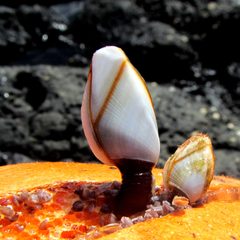
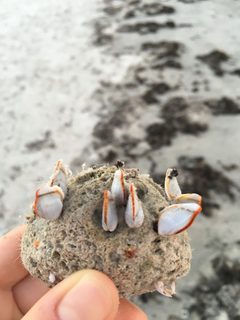
Lepas anserifera is a pedunculate barnacle that attaches to floating substrates including driftwood, ships' hulls, and marine debris. It possesses a capitulum of six white calcareous plates supported by an orange, flexible stalk. The exhibits rapid growth and early maturation, with individuals reaching reproductive size within approximately two weeks under favorable conditions. As a hermaphroditic , it plays a role in marine neustonic and has a distribution in temperate and tropical seas.
Pronunciation
How to pronounce Lepas anserifera: /ˈle.pas anˈsɛ.rɪˌfɛ.ra/
These audio files are automatically generated. While they are not always 100% accurate, they are a good starting point.
Identification
Distinguished from similar Lepas by curved and pointed caudal appendages. The combination of quadrangular, longitudinally furrowed with smooth umbonal areas, trapezoid and deeply furrowed , and wide forked carina provides additional diagnostic characters. Yellow tergal flaps create a distinctive colored rim not present in all .
Images
Appearance
Capitulum enclosed in six white calcareous plates supported by a tough, flexible orange stalk (peduncle). Capitulum approximately 4 cm long, with stalk of similar length. Largest plates are the paired at the stalk end, quadrangular with longitudinal furrows and smooth umbonal area. Paired at the free end are trapezoid and more deeply furrowed than scuta. Carina between terga is wide and forked. Tergal flaps are yellow, creating a colored rim in living specimens. Caudal appendages are curved and pointed—a diagnostic feature distinguishing this from .
Habitat
Neustonic zone, exclusively attached to floating objects including driftwood, ships' hulls, flotsam, and occasionally whales. Occupies ephemeral substrates in open ocean and coastal waters. Rapid growth and early maturation are adaptations to the temporary nature of floating substrates.
Distribution
in temperate and tropical seas. Documented from Brazil (multiple states including Alagoas, Bahia, Espírito Santo, Minas Gerais, Paraíba, Pernambuco, Paraná, Rio de Janeiro, Rio Grande do Norte, Rio Grande do Sul, Santa Catarina, Sergipe, São Paulo) and Japan (Wakayama). Frequently observed washed ashore on beaches attached to flotsam.
Diet
. Uses feather-like cirri fanned out and retracted to create water currents, drawing in zooplankton and detritus for consumption.
Life Cycle
Complex with free-swimming nauplius and cyprid larval stages. Larvae form part of the plankton before settling on suitable substrates and undergoing to become , pedunculate juveniles. Under laboratory conditions (19–29°C), individuals grew from 3 mm to >12 mm capitulum length within 15 days. Maturation timing is positively affected by temperature; food availability (feeding frequency once versus twice weekly) has stronger effect on growth rate than on maturation timing.
Behavior
as , attached by peduncle to floating substrates. Filter feeding involves repeated fanning and retraction of cirri to generate feeding currents. Forms clusters on floating objects.
Ecological Role
Member of neustonic on floating marine debris. Filter feeding activity contributes to nutrient cycling in surface waters. Serves as indicator of oceanic drift patterns and flotsam movement.
Human Relevance
Historical source of the
Similar Taxa
- Other Lepas speciesDistinguished by curved and pointed caudal appendages; other have different caudal appendage
- Cryptolepas rhachianectiAlso attaches to whales, but is a whale-specific barnacle with different plate and does not occur on general flotsam
Misconceptions
Historical myth that barnacle geese (Branta leucopsis) hatched from goose barnacles, including Lepas anserifera, due to the simultaneous occurrence of barnacles on driftwood and the arrival of migratory geese in Britain and Ireland. This misconception persisted before approximately 1100 AD because the breeding grounds of the geese in the far North were unknown, so nests, , and goslings were never observed in Europe.
More Details
Growth and reproduction
Field and laboratory studies in Wakayama, Japan (2006–2008) demonstrated that growth and are positively affected by temperature and food availability. Higher temperatures within the 19–29°C range and more frequent feeding (twice weekly versus once) resulted in greater growth. Temperature had a stronger effect on maturation timing than food availability.
Taxonomic note
Class assignment varies across sources: Thecostraca (NCBI), Hexanauplia (iNaturalist), Maxillopoda (GBIF). All reflect ongoing revisions in barnacle .