
Pentidotea wosnesenskii
(Brandt, 1851)
Rockweed isopod
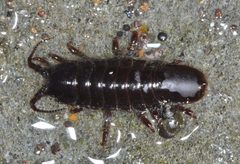
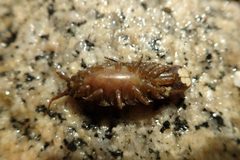
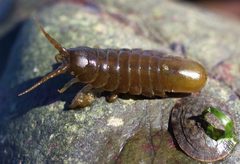
A marine isopod to the temperate North Pacific, reaching up to 40 mm in length. Typically green but capable of color to match its algal surroundings. Frequently shelters under rockweed in the intertidal zone but has been recorded at depths exceeding 900 meters. Named in honor of Russian biologist Ilya G. Voznesensky.
Pronunciation
How to pronounce Pentidotea wosnesenskii: //ˌpɛn.tɪˈdoʊ.tiə wəzˈnɛ.zən.ski.aɪ//
These audio files are automatically generated. While they are not always 100% accurate, they are a good starting point.
Identification
Distinguished from related idoteids by its concave (outwardly curved) rather than indented or notched tail. Maximum length 40 mm. Coloration usually green but adaptable to environment, enabling camouflage against algal substrates.
Images
Habitat
Rocky shorelines with abundant seaweed cover. Primarily intertidal, hiding under rockweed (Fucus ). Recorded from shallow intertidal zones to depths of 919 meters.
Distribution
Temperate Northern Pacific: British Columbia, Washington, and south to San Francisco, California.
Behavior
Has been observed hiding under rockweed in the intertidal zone.
Ecological Role
Prey item for the surf scoter (Melanitta perspicillata).