
Trachelipus rathkii
(Brandt, 1833)
Rathke's Woodlouse
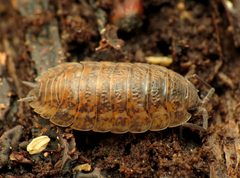
Trachelipus rathkii is a medium-sized European introduced to North America, where it has established across the northern United States and southern Canada. It is distinguished by its for flooding and poorly drained , often dominating riverside and floodplain . The serves as a documented for the Caenorhabditis remanei, which associates with it as dauer larvae on its plates and appendages.

Pronunciation
How to pronounce Trachelipus rathkii: /ˌtrækəˈlaɪpəs ˈræθkaɪ/
These audio files are automatically generated. While they are not always 100% accurate, they are a good starting point.
Identification
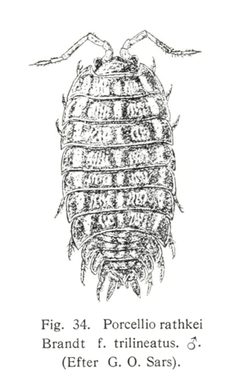
Distinguished from similar woodlice by the combination of: slate grey coloration with three pale longitudinal stripes; five pairs of pleopodal lungs (visible upon examination); two antennal flagellar segments; and strong association with damp, flood-prone . The orange mottling in females can aid identification but is not always present. Porcellio lack the distinct three-stripe pattern and typically prefer drier habitats.
Images
Habitat
Strongly associated with poorly drained, damp environments. Characteristic of riverside meadows and floodplains where it may be the . Also found in scrub, soft eroding cliffs, gravel pits, and churchyards. Shelters under stones and dead wood, beneath bark, in grass litter, tussocks, and flood debris. Notably tolerant of flooding.
Distribution
Native to Europe, occurring across the continent except the Mediterranean Basin. Introduced to North America, with established across most of the northern United States and southern Canada. Westernmost North American records from Alberta.
Host Associations
- Caenorhabditis remanei - phoretic/associative occurs as developmentally arrested dauer larvae on inner surfaces of plates and appendages; experimental persist at least five days
Behavior
Exhibits shelter-seeking under stones, dead wood, bark, and debris. In experimental conditions, dauer larvae have been observed nictating and climbing upon this as potential .
Ecological Role
Documented for Caenorhabditis remanei, providing a substrate for dauer larval survival and . May function as a in floodplain where it achieves high abundance.
Similar Taxa
- Porcellio scaberOverlaps in distribution and use; lacks the three-stripe pattern and has different antennal segmentation; also C. remanei but distinguished by rougher body surface
- Porcellio spinicornisSympatric in some locations but not documented as for C. remanei despite intermingled ; differs in preference and morphological details
- Armadillidium nasatumAlso documented as for C. remanei; distinguished by ability to conglobate (roll into ball) and different body shape
More Details
Nematode Associations
One of few documented natural for Caenorhabditis remanei, with experimental evidence confirming active host-seeking by dauer larvae