
Lirceus
Rafinesque, 1820
Flat Waterslaters
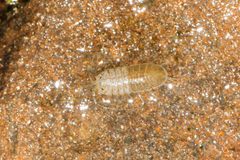
Lirceus is a of freshwater isopod crustaceans in the Asellidae, commonly known as flat waterslaters. The genus contains at least 18 described distributed across southern Canada and the eastern United States, extending westward to the Great Plains. Many species inhabit caves and springs, particularly in the Interior Highlands region (Ozark and Ouachita Mountains), while others occupy surface streams and leaf pack . Two species are listed as endangered or vulnerable on the IUCN Red List.
Pronunciation
How to pronounce Lirceus: /ˈlɜːr.si.əs/
These audio files are automatically generated. While they are not always 100% accurate, they are a good starting point.
Identification
-level identification within Lirceus requires examination of male genital pleopods (pleopod 2), specifically the of the sperm-transfer cannula and associated lateral processes. Interior Highlands species share a common morphological template: a sperm-transfer cannula arising adjacent to a variously papillate or dentate digitiform lateral process, nestled under a broadly rounded or subtriangular apex. Some Ozark species, such as Lirceus bidentatus, exhibit highly modified and bizarre genital morphologies. Cave-dwelling species often show troglomorphic traits including reduced pigmentation and elongated appendages.
Images
Habitat
Freshwater aquatic environments including springs, caves, spring-fed streams, and surface streams with leaf pack accumulations. Many are stygobitic or stygophilic, restricted to groundwater in karst regions. Surface-dwelling inhabit leaf packs in riffles and pools of low-order streams.
Distribution
Southern Canada and eastern United States, extending west to the Great Plains. Center of diversity in the Interior Highlands (Ozark and Ouachita physiographic provinces) with numerous cave and spring . Documented from Pennsylvania, Virginia, West Virginia, Ohio, Indiana, Illinois, Kentucky, Tennessee, Missouri, Arkansas, Kansas, Oklahoma, Louisiana, and Alabama.
Behavior
Exhibits fish avoidance in response to chemical cues from predatory fish skin mucus, reducing activity and seeking in covered microhabitats. show seasonal abundance fluctuations with peak densities in late spring and early summer. Some populations demonstrate physiological and behavioral adaptations to climatic stresses including drought and high temperatures.
Ecological Role
Facultative in low-order stream detrital , contributing to leaf litter processing and decomposition. Leaf processing rates vary with isopod size and are influenced by fish presence through indirect trait-mediated effects.
Human Relevance
Two are listed as endangered or vulnerable on the IUCN Red List. Serves as a model organism for studies of subterranean evolution, ecological speciation, and the effects of environmental stressors including radiation. Taxonomic revisions continue to clarify species boundaries and distributions.
Similar Taxa
- CaecidoteaAnother of North American Asellidae; distinguished by genital pleopod and typically broader geographic distribution with less cave
- AsellusEuropean and western North American asellid ; distinguished by geographic range and male pleopod
More Details
Conservation Status
Two of 15 historically recognized are listed as endangered (EN) or vulnerable (VU) on the IUCN Red List; cave-dwelling species with restricted ranges are particularly vulnerable to groundwater and disturbance.
Recent Taxonomic Changes
Three new were described from the Interior Highlands in 2022 (L. slayorum, L. ozarkensis, L. robisoni), and additional taxonomic revisions have modified distributions of previously recognized species.
Sources and further reading
- BugGuide
- Wikipedia
- GBIF taxonomy match
- iNaturalist taxon
- NCBI Taxonomy
- Catalogue of Life
- Ecology of Two Populations of an Aquatic Isopod, Lirceus Fontinalis Raf
- Ecology of an Aquatic Isopod, Lirceus fontinalis Raf., Emphasizing Radiation Effects
- Habitat Use and Fish Avoidance Behaviors by the Stream-Dwelling Isopod Lirceus fontinalis
- Slater swap: Taxonomic analyses modify distributions of two species of Lirceus Rafinesque, 1820 (Isopoda: Asellidae) and identify a new species from central Ohio, USA
- Effects of Species of Leaves and Conditioning Time on Vernal Colonization by Temperate Lotic Isopods (Lirceus sp.)
- Indirect effects of fish on foraging behaviour and leaf processing by the isopod Lirceus fontinalis
- Freshwater isopods of the genus Lirceus from caves and springs of the Interior Highlands, USA, with description of three new species (Isopoda: Asellidae)
- A new troglobitic isopod of the genus Lirceus (Asellidae) from Southwestern Virginia, with notes on its ecology and additional cave records for the genus in the Appalachians