
Asellus
Geoffroy, 1762
Eurasian Waterslaters
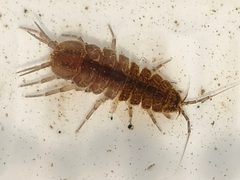
Asellus is a of freshwater isopod crustaceans in the Asellidae, commonly known as Eurasian waterslaters. The genus contains approximately 20 described divided among three subgenera: Asellus (Asellus), Asellus (Arctasellus), and Asellus (Mesoasellus). Species in this genus are primarily aquatic, inhabiting lakes, canals, and other freshwater systems across Europe and Asia. The most studied species, Asellus aquaticus, serves as an important model for ecological research on , -prey interactions, and to different environments.
Pronunciation
How to pronounce Asellus: //əˈsɛləs//
These audio files are automatically generated. While they are not always 100% accurate, they are a good starting point.
Identification
Asellus are distinguished from terrestrial isopods (woodlice) by their fully aquatic lifestyle and associated adaptations. They can be separated from other freshwater isopod by characteristics of the Asellidae, including specific pleopod adapted for aquatic respiration. Species-level identification requires examination of detailed morphological features such as male pleopod structure and body proportions. Asellus aquaticus is characterized by its elongated body form and is one of the most widespread and commonly encountered species in European freshwater systems.
Images
Habitat
Freshwater aquatic environments including lakes, canals, ponds, and slow-moving waters. Asellus aquaticus occurs on two main substrate types: bare sediment and vegetation (macrophytes). are described as phytophilic, with individuals protected by vegetation and freely distributed where are absent. Some populations have adapted to hypogean (subterranean) environments.
Distribution
Europe and Asia. Documented from the United Kingdom (Lancaster Canal), Netherlands (Tjeukemeer), and various locations across Eurasia including Japan, Russia, and Central Asia. The shows a broad Palearctic distribution with ranging from western Europe to eastern Asia.
Seasonality
Reproductive activity occurs during spring and summer months. In temperate regions, three main periods of per year have been documented, with replaced twice annually. Activity patterns vary with local environmental conditions and presence.
Life Cycle
are replaced twice yearly with three main periods per year. production is positively correlated with body length; summer sizes are typically smaller than spring broods. Development includes progression from egg to to stages, with overlapping present in populations.
Behavior
Exhibits substrate selection , occurring on both bare sediment and vegetation. Shows crowding behavior in restricted plant beds when becomes limited; disperses from vegetation onto open sediment under pressure. distribution is patchy when protected by vegetation, becoming more uniformly distributed in the absence of fish . Some populations have adapted to subterranean environments with associated behavioral modifications.
Ecological Role
Functions as prey for benthivorous fish such as tench, which selectively target larger size classes. Serves as an important component of freshwater , transferring energy from detritus and vegetation to higher . Vegetation-associated act as phytophilic prey whose availability to benthic feeders is mediated by macrophyte grazing activity. Presence of grass carp can increase Asellus abundance in remaining plant beds while causing compression.
Similar Taxa
- Oniscus asellusSimilar but belongs to a different of terrestrial isopods ( Oniscidae). Oniscus asellus is a that lives in soil and leaf litter, not aquatic . The shared specific epithet 'asellus' has caused confusion, but these genera are ecologically and taxonomically distinct.
- Asellus meridianusCongeneric that co-occurs in some . Asellus meridianus reproduces at smaller body sizes and achieves higher in overlapping size classes compared to A. aquaticus, though both species have similar total seasonal reproductive output and timing.
More Details
Subgeneric Classification
The Asellus is divided into three subgenera: Asellus (Asellus) Geoffroy, 1762 containing the majority of including A. aquaticus; Asellus (Arctasellus) Henry & Magniez, 1995 containing cold-adapted species from northern regions; and Asellus (Mesoasellus) Birstein, 1939 with limited representation.
Research Significance
Asellus aquaticus has been extensively studied as a model organism for freshwater , particularly regarding , -prey interactions, and the effects of modification by grazing fish. Recent research has also examined the potential role of related terrestrial isopods in plastic fragmentation, though this specifically involves Oniscus asellus rather than aquatic Asellus .
Sources and further reading
- BugGuide
- Wikipedia
- iNaturalist taxon
- NCBI Taxonomy
- Catalogue of Life
- Oniscus asellus Archives - Entomology Today
- Study Examines Insects' Role in Plastic Pollution
- isopod with plastic - Entomology Today
- Oogenesis in oniscus asellus
- A comparison of the population ecology of Asellus aquaticus (L.) and Asellus meridianus rac. in the reed beds of the Tjeukemeer
- Influence of grass carp and tench on the ecology of Asellus aquaticus
- SOME OBSERVATIONS ON THE LIFE HISTORY OF ASELLUS AQUATICUS (L.) AND ASELLUS MERIDIANUS RACOVITZA (CRUSTACEA: ISOPODA)
- Physiological and behavioural adaptations of an epigean and a hypogean dwelling population of Asellus aquaticus (L.) (Crustacea, Isopoda)