
Stygobromus pecki
(Holsinger, 1967)
Peck's cave amphipod
Stygobromus pecki is a small, eyeless, unpigmented cave-dwelling amphipod to four spring systems in Comal County, Texas. It is a federally listed in the United States and classified as Endangered on the IUCN Red List due to its extremely limited geographic distribution. The inhabits subterranean limestone aquifers and exhibits adaptations typical of stygobitic organisms, including light sensitivity and starvation resistance. Very few individuals have been documented since its listing, and no formal recovery plan or comprehensive assessment exists as of 2022.
Pronunciation
How to pronounce Stygobromus pecki: /stɪˌɡoʊˈbroʊməs ˈpɛki/
These audio files are automatically generated. While they are not always 100% accurate, they are a good starting point.
Identification
Distinguished from other stygobitic amphipods by its specific association with Edwards Aquifer spring systems in Comal County, Texas. The combination of complete eyelessness, lack of body pigment, small size (<11 mm), and documented occurrence only in Comal Springs, Hueco Springs, Landa Park, and Panther Canyon separates it from other regional amphipods. Genetic or morphological differentiation from would require specialized examination.
Images
Appearance
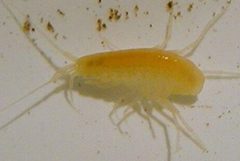
Small aquatic crustacean reaching up to 10.5 mm in length, though most individuals are under 5 mm. Body is laterally flattened with five pairs of legs and two pairs of . Completely eyeless and unpigmented (white or translucent) as characteristic of the Stygobromus. Some in Comal Springs display orange coloration derived from dietary , while Hueco Springs populations remain white. not prominently described.
Habitat
Subterranean aquatic in limestone aquifers, specifically within hollowed-out limestone spaces of the Edwards Aquifer system. Found in spring openings, seeps, and upwellings with permanent darkness. Associated with gravel, rocks, and organic debris including leaf litter, roots, and wood. Occasionally observed near surface areas around spring openings but rarely leaves subterranean environment due to light sensitivity.
Distribution
to Comal County, Texas, United States. Documented from four localities: Comal Springs, Hueco Springs, Landa Park, and Panther Canyon in New Braunfels. Historical presence in potentially dried springs (San Pedro Springs, San Antonio Springs) unconfirmed. No verified records outside this restricted area.
Diet
Opportunistic feeder consuming bacterial biofilm, debris, smaller including ostracods, and organic matter. Dietary from sources such as leaf litter influence body coloration.
Life Cycle
Direct development with brooded by female. Average clutch size approximately 5 eggs with mean incubation of 50 days; of up to 10 young recorded. approximately 2 mm at hatching. Captive-reared individuals reached 9 mm in 14 months and produced offspring the following year. time likely one year based on related amphipods, though unconfirmed. Lifespan unknown; wild-caught survived in captivity for at least 2.7 years.
Behavior
Strongly photophobic; rarely leaves permanent darkness of subterranean . Exhibits behavioral, physiological, and metabolic adaptations to low-energy cave environments including high starvation resistance. Likely moves between caves and springs via underground water connections. Poor ability; does not colonize downstream gravel beds readily.
Ecological Role
Scavenger and opportunistic in subterranean aquatic . Consumes biofilm and organic debris, contributing to nutrient cycling in aquifer systems. Prey for other cave-dwelling organisms where co-occurs.
Human Relevance
Federally listed under the U.S. Endangered Species Act. Subject of conservation efforts by the Edwards Aquifer Conservation Program (EAHCP). Threatened by groundwater extraction, urbanization, and aquifer depletion. No direct economic or cultural significance; conservation value lies in biodiversity protection and aquifer health indicator.
Similar Taxa
- Other Stygobromus speciesShare eyeless, unpigmented and stygobitic ; distinguished by geographic distribution and specific spring system associations
- Surface-dwelling amphipods (various families)Possess and body pigment; occur in surface waters rather than subterranean aquifers
More Details
Conservation Status
Listed as Endangered under the U.S. Act and on the IUCN Red List. As of April 2022, no 5-year review, Status Assessment, or recovery plan exists. Only six individuals documented from Miller's Cave and two from Thompsons Meadow Spring aquifer since listing. Edwards Aquifer Conservation Program (EAHCP) conducts monitoring and protection activities.
Threats
Primary threats include declining water levels in the Edwards Aquifer due to human extraction for irrigation and municipal use; urbanization causing flooding, erosion, and pollution; siltation; and general degradation. Limited distribution makes vulnerable to stochastic events.
Research Gaps
details including complete time, field lifespan, and remain unknown. No formal estimates available for Landa Park or Panther Canyon. Taxonomic relationships with require further study.
Sources and further reading
- BugGuide
- Wikipedia
- GBIF taxonomy match
- iNaturalist taxon
- NCBI Taxonomy
- Catalogue of Life
- RJ Millena: from Entomology-Focused Kindergartener to Scoring Cover of Journal With Her Research | Bug Squad
- Suffering for Science: Why I Have Insects Sting Me to Create a Pain Index
- Insect-Based Chicken Feed Can Benefit Farmers and Environment
- New Technique May Help Farmers Identify the European Corn Borer
- Dust Baths and Longer Beaks Can Make Cage-free Chickens into Mite-free Chickens
- Chrysididae | Beetles In The Bush