
Calliopius laeviusculus
(Krøyer, 1838)
Planktonic Amphipod
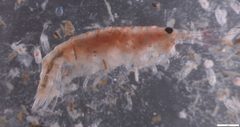
Calliopius laeviusculus is a marine amphipod crustacean distributed across the North Atlantic in both European and North American waters. The exhibits a semiannual in southern parts of its range, with releasing young in spring and early summer. are tightly coupled to seasonal food availability, particularly capelin deposits. Multiple per year occur in warmer regions, while single-generation cycles prevail in colder northern waters.
Pronunciation
How to pronounce Calliopius laeviusculus: /kæˈliːoʊpiəs laɪˌvjuːsˈkjuːləs/
These audio files are automatically generated. While they are not always 100% accurate, they are a good starting point.
Images
Habitat
Rocky intertidal and nearshore marine environments. In the northwestern Atlantic, found from Hudson Bay south to Long Island Sound. Occupies coastal waters where capelin and other marine fish deposit on substrate.
Distribution
North Atlantic: Europe and North America. Western Atlantic range extends from Hudson Bay to Long Island Sound. Documented in Newfoundland and Labrador coastal waters.
Seasonality
Active and reproductive during spring through late summer. from approximately August through November–December. peaks in late summer (July–August) in Newfoundland waters. Young released from spring until late summer.
Diet
Actively preys on fish , particularly capelin (Mallotus villosus) eggs. Opportunistic feeding on intertidal fish egg deposits.
Host Associations
- Mallotus villosus - growth tightly coupled to seasonal availability of capelin
Life Cycle
Semiannual in Newfoundland: release young in April, May, and July. Cohorts from April–May releases reach sexual maturity within summer, reproduce, and produce second peak in early August. In Labrador, single per year with spring release of young and autumn maturation. Females may produce multiple in favorable conditions.
Behavior
Aggregative response to patchy food resources. Rapid to capelin spawning events. larger than summer individuals.
Ecological Role
Significant of fish in coastal . Links capelin spawning events to higher . Potential impact on capelin year-class strength through egg pressure.
More Details
Temperature and latitudinal effects on life history
Reproductive patterns and time vary with latitude and temperature. In Newfoundland waters, 50% of females mature at 5.6 mm (summer) and 6.7 mm (winter); in Labrador, females up to 10 mm may remain . does not vary seasonally in Newfoundland.
Sources and further reading
- BugGuide
- Wikipedia
- GBIF taxonomy match
- iNaturalist taxon
- NCBI Taxonomy
- Catalogue of Life
- Some aspects of the biology of Calliopius laeviusculus (Krøyer) (Crustacea, Amphipoda) in the northwestern Atlantic
- Match/Mismatch between the Abundance of Marine Fish Eggs and Invertebrate Predators: An Analysis of Calliopius laeviusculus (Amphipoda: Gammaridae) Population Growth Relative to the Seasonal Spawning Cycle of Capelin (Mallotus villosus)