
Calliopiidae
G.O. Sars, 1893
Genus Guides
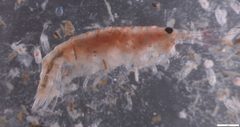
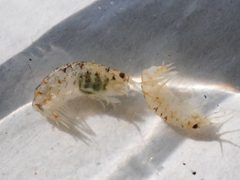
1Calliopiidae is a of hyperbenthic amphipods distributed across the North Atlantic and North Pacific oceans. Members inhabit diverse marine environments including subtidal waters, hydrothermal vents, and the hyperbenthic zone immediately above the seafloor. The family includes the newly described Bathya from deep-sea hydrothermal vents and Calliopius associated with macroalgae.
Pronunciation
How to pronounce Calliopiidae: //kəˌlaɪ.oʊˈpi.aɪ.iːdiː//
These audio files are automatically generated. While they are not always 100% accurate, they are a good starting point.
Images
Habitat
Hyperbenthic zone (water column immediately above seafloor). Specific occur in subtidal waters among floating and brown (e.g., Sargassum horneri), and in chemically reduced deep-sea environments including hydrothermal vent systems.
Distribution
North Atlantic: seas around the Greenland-Iceland-Faeroe-Ridge. North-west Pacific: Okinawa Trough, Korean waters (Ulleungdo Island, East Sea). Records from Denmark, Norway, and Sweden.
Host Associations
- Sargassum horneri - floating ; substrate for Calliopius ulleungensis
Ecological Role
Hyperbenthic amphipods occupy a key position in the water column immediately above the seafloor, serving as potential prey for demersal and contributing to nutrient cycling in benthic-pelagic coupling.
More Details
Taxonomic note
placement within Amphipoda follows the classification: Senticaudata > Hadziida > Hadziidira > Calliopioidea > Calliopiidae. The family has been recently expanded with deep-sea vent-associated (Bathya brevicarpus).
Biogeographic patterns
The exhibits distinct biogeographic patterns across different seas in the North Atlantic region around the Greenland-Iceland-Faeroe-Ridge, suggesting sensitivity to oceanographic conditions.
Sources and further reading
- BugGuide
- Wikipedia
- GBIF taxonomy match
- iNaturalist taxon
- NCBI Taxonomy
- Catalogue of Life
- Bathya brevicarpus gen. et sp. nov. (Amphipoda: Senticaudata: Calliopiidae), from hydrothermal vents, Okinawa Trough, North-west Pacific
- Distribution and diversity of the hyperbenthic amphipod family Calliopiidae in the different seas around the Greenland-Iceland-Faeroe-Ridge
- First record of the family Calliopiidae (Crustacea, Malacostraca, Amphipoda) from Korean waters, with description of new species Calliopiusulleungensis sp. nov.